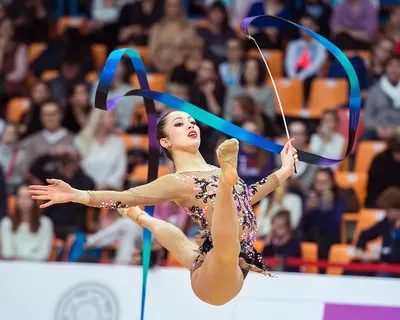
It’s like dancing. It moves like water. But artistic gymnastics is a sport, pure and simple. It requires the same discipline as artistic gymnastics, but you only change the ribbons, clubs, ball, hoop and rope. These are not just props. They are an extension of the body.
Its roots go back centuries. This custom dates back to the 18th century. Early forms focused on systematic physical movements. Over time, it became integrated into dance. It is currently located next to artistic gymnastics. One uses a vaults and bars. The other uses apparatuses and grace. Both require precision.
For decades it was not an official Olympic sport. In 1984, things changed. The Los Angeles Olympics were organized for the first time in an individual competition. Before that, the gymnasts performed in 1948, 1952 and 1956. These are demonstration or informal events. They do not count towards the medal table. Their debut in 1984 was the real beginning.
Group competition arrived later. Team competition was introduced at the 1996 Atlanta Olympics. Here, five gymnasts move as one unit as a unit. It’s all about synchronization. One poorly timed pass can ruin the score.
The World Championships also tracked this growth. It has been organized every two years since 1963. Host cities are constantly changing. The sport remains consistent. It is a test of flexibility, strength and artistry.
Rhythmic gymnastics is not just a performance. It’s rigorous movement training disguised as ballet.
Why did the Olympics take so long? Politics also played its role. Cultural perceptions of sports are different. However, when it arrived, it was stayed. These apparatuses add complexity. The ribbons can get tangled. The ball can roll. The hoop may wobble. These elements create drama. They create intense moments that cannot be found in pure dance.
This sport attracts fans who appreciate the nuances. It’s not about who lifts the most weight. What matters is who can make a difficult look easy. A person who can balance on one toe while holding a ribbon around their neck. Who will catch the bat thrown from the other side of the stage?
Synchronized swimming also contains this DNA. Both have movement and beauty. Both require years of practice. Both require pain tolerance. The difference is in the medium. Water provides resistance. The floor causes friction. Both require control.
Rhythmic gymnastics is constantly developing. New device combinations are introduced. Difficulty scores rise. The athletes are getting stronger. Routines speed up. But the core remains. This is a physical exercise. It’s systemic. It’s beautiful.
You can watch the World Championships online. You can follow the Olympic cycle. You can watch the World Championships. It does not hide in obscure leagues. It’s a global stage. Every four years, the spotlight comes back on. The World Championships organized every two years enriches this tradition even more.
The next DNAration of generation is already being trained. They hold clubs. they stretch. They dream of the mat. The history stretches back centuries. The future is bright.
Who catches the ball? Who hold the pose? The answer is revealed in the next routine.
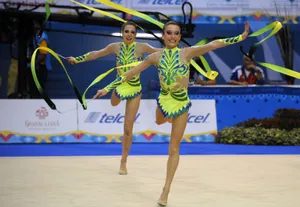
The clock starts ticking. You only have 75-90 seconds to shine as an individual. athlete. Part of the equipment. It’s a touch of grace and precision. Group routine? It’s a marathon of adjustments. Five gymnasts form a unit and perform for 2 minutes 15 seconds to 2 minutes 30 seconds.
They don’t just use gear. Perform an action where 5 people are holding the same device. Next comes another set of mixers. confusion? No, it’s controlled chaos. Everything moves to the music. It’s always music. The stage area is small, only 13 square meters. You can’t hide there. Every step is measured.
Equipment is very important
They had a game changer on their hands. The length of the rope is not random. Scaled to the height of the gymnast. Taller athletes use longer ropes. basket? This is a plastic or wooden ring with an inner diameter of 80-90 cm. Big enough to cross. Small enough to spin without losing control.
The ball is small. Crowded. It is a solid ball made of plastic or rubber with a diameter of 18-20 cm. But weight is important. It should weigh at least 400 grams. If it’s too light, it won’t bounce properly. If it’s too heavy, it pulls. Clubs are in pairs. The length of each is 40-50 cm. It should weigh at least 150 grams. The heavier the racket, the more wrist strength you need. Lighter objects fly faster but fall more easily.
Tape dynamics
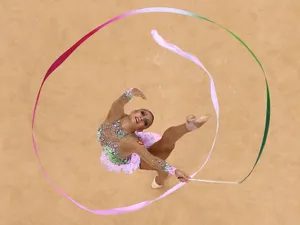
And then there’s tape. It’s not just a piece of fabric. It has a satin tail 6 meters long and 4-6 centimeters wide. They are tied to sticks or sticks. The length of the rod is 50-60 cm. Flexible wood or synthetic material. must be bent. Hard sticks restrict tape flow. When the gymnast spins the bar, the ribbon spins with him. cycle. spiral. trap. If the tape touches the floor, points are deducted. The stick remained in the air. The ribbon represents air.
“The installation is not just a support, it is an extension of the frame.”
Each song has certain rules. No need to guess. There are no immediate specifications. A ball is not a rope. The club is not basketball. You can tell the difference because sport demands a difference. There is no room for error in the Square arena. Music sets the rhythm. There were challenges with the installation. Gymnasts act as a bridge between the two.
What happens if the stick breaks? Or is the tape broken? It won’t end. It ends. Or it crashes. There is nothing wrong with rhythmic gymnastics. The specifications are very strict. Performance is consistent. The excitement is real.
Scoring techniques of rhythmic gymnastics
Rhythmic gymnastics at the highest level includes more than just turns. It’s about selling the illusion of effortless elegance under pressure. A jury of 12 judges carefully analyzes each performance, taking into account three different pillars: Difficulty, artistry and Performance.
The simplicity of mathematics is brutal. Try a complex movement (difficulty), perform it cleanly (execution), and make it look beautiful (artistic). But this is where most casual viewers stumble. Acrobatics? They matter. But they are not the king of this sport.
Artistry counts far more, artistry is much more important than intense acrobatics.
You can throw a backflip off the charts, but if your lines don’t flow, your gestures are stiff, or your facial expression reads like you’re in pain, you’re going to lose. The judges are looking for originality in the routine. They want to see the story. They want to see how the apparatus flows with the lines of the body. It doesn’t matter how high you jump. It’s about the long the jump feels.
This creates a strange hierarchy in elite competition. Athletes who master the subtle shifts in weight, the precise timing of ribbon wave, and the emotional arc of music will always outperform those who rely purely on physical strength. This is a sport where style is substance. And in a field where 12 pairs of eyes watch for every little deviation, style wins. Again.