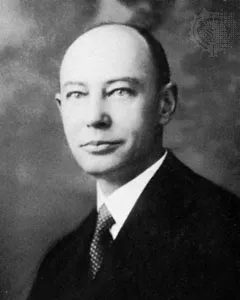
Pernicious anemia used to be a death sentence. There were no treatments. If you had it, you eventually died. That changed because of George Richards Minot, a physician who helped turn a fatal condition into a manageable disease.
Minot was born in Boston on December 2, 1885. He earned his medical degree from Harvard University in 1912. His career spanned several major Boston hospitals. He worked at Massachusetts General Hospital. He spent time at the Collis P. Huntington Memorial Hospital and the Peter Bent Brigham Hospital. From 1928 until he died, he directed the Thorndike Memorial Laboratory at Boston City Hospital.
Minot faced his own health crisis. He was diagnosed with diabetes in 1921. The disease made it hard for him to work. The situation improved in 1923. Insulin had been synthesized the previous year. Minot began using it. It saved his life.
The breakthrough for anemia came from a different angle. George Whipple studied dogs. He induced anemia in them by causing excessive bleeding. He noticed something important. A diet of raw liver reversed the condition.
Whipple and William Murphy tested this idea on humans in 1926. They fed patients half a pound of raw liver a day. The results were dramatic. The patients improved significantly.
Minot joined forces with American chemist Edwin Cohn. They figured out how to prepare effective liver extracts. Patients could take these extracts orally. This became the primary treatment for pernicious anemia for over two decades.
The treatment lasted until 1948. That year, scientists isolated a specific therapeutic factor. They named it vitamin B12. The raw liver diet was no longer needed.
Minot died on February 25, 1950, in Brookline, Massachusetts. He shared the 1934 Nobel Prize for Physiology or Medicine with Whipple and Murphy. Their work shifted the trajectory of a disease that had claimed countless lives.
The introduction of the raw-liver diet transformed pernicious anemia from an invariably fatal disease into a treatable condition.
The shift from raw liver to isolated vitamin B12 marked a major advancement in medicine. It allowed for more precise dosing and easier administration. But the foundation was laid by Minot and his colleagues. They proved that what you eat can change your biology.
This discovery didn’t just save Minot. It saved thousands of others. The mechanism was complex. The solution was surprisingly simple. Liver.
We still use vitamin B12 today. It is essential for nerve function and blood formation. Deficiencies can cause fatigue and damage. The history of this treatment reminds us how observation leads to breakthroughs. Whipple watched dogs. Minot treated humans. The result was a cure.
The story of pernicious anemia is one of medical evolution. It shows how experimental approaches can lead to standard care. Raw liver was the first step. Vitamin B12 was the refinement. Both were necessary.
Minot’s legacy isn’t just the prize. It’s the patients who lived because of it. They went from certain death to manageable health. That is a significant shift.
The road from raw liver to synthetic vitamins wasn’t smooth. It required rigorous testing. It required skepticism to be overcome