


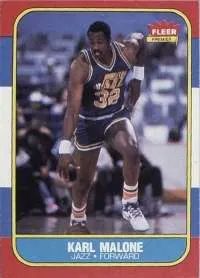
Karl Malone wasn’t just a basketball player. He was a force of nature wrapped in a jersey. For eighteen years, he was the most dependable forward the NBA had ever seen. He missed only ten games in that entire stretch. Ten. While other stars sat out with minor tweaks, Malone was out there, collecting hardware like it was going out of style. Two MVPs. Two Olympic gold medals. Two All-Star Game MVPs.
He was the definition of reliability.
In a 1992 poll by Sports Illustrated, coaches and GMs voted him the best forward in the league. They gave him a two-to-one margin over Charles Barkley. That’s not just winning. That’s dominating. Malone, known as “The Mailman,” didn’t just deliver. He revolutionized the power-forward position in the 80s and 90s. Before him, nobody combined size with speed quite like he did. Standing 6-foot-9 and weighing 256 pounds, he was a contradiction. A runaway train on the fast break.
The Mechanics of Dominance
Opponents didn’t just lose to Malone. They got hurt trying. If he hit you with a three-point play, you were lucky to walk away. He led the NBA in free-throw attempts for five straight seasons from 1988-89 to 1992-93. Seven times total.
His game wasn’t limited to alley-oops. He was a bulldog in the low post. Unstoppable strength. He grabbed boards for fun. As his career went on, his outside shooting and passing got better, too. Defensively, he loved the grit. It got ugly. Dominique Wilkins once accused him of dirty play. In a 1991 game against Detroit, Malone elbowed Isiah Thomas so hard it opened a gash above the guard’s eye. Forty stitches. Malone didn’t care. He thrived in the rough and tumble.
From Rural Louisiana to the NBA Draft
Born July 24, 1963, in rural Summerfield, Louisiana, Malone was the eighth of nine kids. He had wild hair and didn’t care about school. He led his high school team to three straight state championships, but bad grades nearly killed his college dreams. He spent a year at Louisiana Tech University just trying to get eligible.
Bobby Knight cut him from the ’84 Olympic team. But in the 1984-85 season, Louisiana Tech went 29-3 and hit the third round of the NCAA Tournament. Malone forfeited his final year of eligibility and went 13th in the 1985 NBA draft. Ahead of him were Jon Koncak, Joe Kleine, Kenny Green, and Keith Lee. You can imagine how that felt.
The Stockton Connection
As a rookie with the Utah Jazz, Malone learned from Adrian Dantley. Dantley was wrapping up his career. Malone averaged 14.9 points and 8.9 rebounds. He made the All-Rookie Team. Before his second season, the Jazz traded Dantley to Detroit.
By his third season, Malone was averaging 27.7 points and 12.0 rebounds. He was the only player in the NBA to rank in the top five in both categories. He went from a happy-to-be-there rookie to a superstar in three years.
Then came John Stockton.
Stockton joined the Jazz starting lineup in 1987. The fit was perfect. Malone piled up points at a near-record pace. Stockton became the all-time assist leader. Together, they were a nightmare for defenses. Malone’s best season was 1989-90. He scored 31.0 points per game. Second only to Michael Jordan. He made the All-NBA First Team eleven times in a row starting in 1988-89.
The Snub and the Legacy
The Jazz had their moments. At the 1993 All-Star Game in Salt Lake City, Malone and Stockton shared the MVP. Malone had 28 points. Stockton had 15 assists. But in the playoffs? Nothing. They never won an NBA title. Disappointments piled up year after year.
Malone eventually left Utah for the Los Angeles Lakers. He played one more season. Retired in 2004. His stats are historic. Most free throws attempted and made. Most defensive rebounds. 36,928 career points. Second only to Kareem Abdul-Jabbar.
He’s often overlooked compared to Barkley or Patrick Ewing. Maybe because he played in a small market. Maybe because Stockton shared the spotlight. But in 1990, fans snubbed Malone for the Western Conference All-Star starter spot. They picked Lakers center A.C. Green.
Malone snapped.
On January 27, 1990, against the Milwaukee Bucks, he dropped 61 points and 18 rebounds in just 33 minutes. 21 field goals. 19 free throws. He announced he was canceling his boycott of the All-Star Game. Ironically, he never played in that game anyway. An injury.
He left the league with more points than almost anyone. A legacy built on durability and dominance. But no ring. Just the numbers, the injuries, and the memory of a man who simply refused to stay on the bench.