There is a strange logic to a gentleman’s agreement. It’s a contract with no paper trail. No signatures. No file folders. Just honor. Trust. You rely on the other party to do the right thing because breaking their word carries a social weight heavier than any legal penalty.
It sounds archaic for pro sports, right? We expect codified rulebooks. Referees with whistles. Instant replay reviews. But the world of athletics runs on more than just the official statutes. The unofficial rules matter just as much. They are the invisible walls.
Don’t run up the score on a team that is already beaten. Pass the ball to a teammate who is one catch away from history. Violate these norms, and you won’t get a technical foul. You won’t get a yellow card. Your peers will make you feel it. Maybe it’s angry words in the post-game press conference. Maybe it’s months of staring over your shoulder, waiting for payback on the field or court.
This brings us to NASCAR’s most famous unwritten rule. The gentleman’s agreement. It governed the behavior of drivers in the top series for nearly 30 years. It never appeared in a single rulebook. Yet everyone followed it. Everyone respected it. Until they didn’t.
Why the Unwritten Rules Matter in Motorsports
Racing is a contact sport disguised as a precision test. Cars are heavy, fast, and fragile. The margin for error is measured in inches. Written rules exist to define the track limits, the car specifications, the penalties for infractions. But they cannot define intent. They cannot stop a driver from driving someone into the wall on purpose.
The gentleman’s agreement filled that gap. It was a mutual understanding among competitors. You race hard. You try to win. But you do not intentionally wreck another car. Not out of spite. Not to hurt someone physically. That line was sacred.
Breaking it had consequences. Not from the sanctioning body. From the other drivers.
Imagine being the guy who breaks that trust. You might win the race. You might get the prize money. But for months, you are alone. Other drivers won’t block for you. They won’t help you back onto the track if you spin. They will wait for their moment. And when you make a mistake, they will take it.
The Era of the Gentleman’s Agreement
This code of conduct held sway for decades. It shaped the culture of the sport. It created a sense of camaraderie, even among fierce rivals. Drivers knew that respect was earned on the track, not just by titles.
The agreement wasn’t perfect. There were gray areas. Accidents happen. Intent is hard to prove. But for almost 30 years, the threat of peer enforcement kept things in check. It was a self-policing system. One that relied on the honor of the participants.
Then, something changed. The agreement faded. Vanished. Why?
Was it simply that there were no gentlemen left in racing? Did the sport become too competitive? Too lucrative? Or did something else make the old ways obsolete?
The shift wasn’t sudden. It was a slow erosion. A series of incidents that tested the boundaries of the unwritten rule. Each one pushed the limits further. Until the limit was gone.
Why drivers used to slow down on caution
For decades, the finish line wasn’t just a boundary. It was a checkpoint. Before modern timing systems, human scorers tracked positions by watching cars cross the start/finish line. If a caution flag waved, the order stayed frozen until that next pass. The rule was simple: race to the line. Even if the track was littered with wrecked metal, you pushed hard.
Safety was an afterthought.
Crews couldn’t reach an accident until every driver crossed the line. If a driver was trapped and bleeding, you waited. And if you were a lap down? You raced for your life. Getting back to the lead lap meant staying near the front. Missing the line meant staying back. It was dangerous logic.
The unwritten code of the 1970s
NASCAR never changed the rule. The danger remained. So the drivers did.
Richard Petty, Buddy Baker, Cale Yarborough, and David Pearson looked at the carnage and decided enough was enough. They created the gentleman’s agreement. It wasn’t in the rulebook. It was a handshake. When the caution came out, leaders slowed down. They held their spots. Passing was technically legal. They just chose not to do it.
“They all went off on their own and made an agreement: When the caution comes out, let’s throw up our hand, and everybody should whoa up at the same time,” NASCAR President Mike Helton said in 2003. “That’s the gentleman’s agreement. It’s been working pretty well up until recent years.”
It worked because the guys making it were the best. They had the clout. Lapped cars near the front got a break, too. Leaders would drag their tires a little more to let one desperate car slip by and regain the lead lap. Respect. Tradition. It held for thirty years.
When the money changed the game
The code broke in 2003.
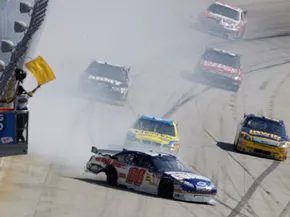
It started at Sonoma, California. Robby Gordon passed Kevin Harvick during a full-course caution. Gordon won the race. The move was legal. It was also universally hated. Other drivers confronted him. The press tore into him. But the win stood.
Then Jimmy Johnson did it at Chicagoland. He passed Michael Waltrip under caution. The floodgates opened.
NASCAR panicked. Helton warned drivers to self-police. It didn’t work. Why?
Fans have theories. Some say corporate sponsorship changed the stakes. When millions are on the line, honor costs too much. Others argue today’s drivers lack the old-school loyalty. The truth is stranger. The infrastructure for cheating was finally ready.
The technical fix that ended the era
NASCAR needed a new solution. They looked at the scoring system.
The fix was simple, if frustrating. Instead of scoring positions when cars crossed the line after a caution, NASCAR reverted to the last legally scored lap.
Here is how it works. If the leader completes lap 49, and you pass them on lap 49 before the caution, the pass is wiped clean. Positions reset to where they were at the end of lap 49.
It’s common at local short tracks. It rarely happens in Cup Series races. But it stops the chaos.
The temptation of the multi-car team
The old agreement kept things fair among individuals. The new rule prevents team orders.
In modern NASCAR, teams run multiple cars. Cheating is tempting. Imagine this: your teammate stalls out on purpose. Or spins. On the exact lap another teammate is about to pass a rival. Under the old system, that pass counted. The rival lost the position.
Now? The pass is erased. The timeline resets. Collusion becomes harder to execute. The gentleman’s agreement died so the sport could police its biggest players.
Did it kill the spirit of the track? Maybe. Did it save drivers from driving into wrecks for a marginal gain? Absolutely.
The line is no longer a race. It’s a reset button.
The 2003 season changed everything for NASCAR. Before that, drivers would race hard to the finish line even when a yellow flag waved. It was an unwritten code. The new rule froze a driver’s position the instant caution was thrown. There was no point in racing back to the line. You couldn’t gain ground. The transponder system made this possible. It settled the debate once and for all.
But freezing the field created a new problem. If you fell a lap down, you were stuck there. Parity matters in motorsports. Fans want to see cars on the same lap. So NASCAR introduced the Lucky Dog rule. It has other names too. The Free Pass. The Beneficiary Rule. The official rulebook uses the last name.
Who Gets the Free Pass?
When caution comes out, the lapped car with the best track position gets a lap back. Simple as that. If three cars are a lap down, the one ahead of the pack gets their lap back.
There are no limits. You can use this rule as many times as you want in a single race. You can be several laps down and still get back into contention. This rule has produced some wild outcomes.
Take Kyle Busch. He used the Beneficiary Rule five times in a row. He had lost five laps due to mechanical trouble at a road course. Road courses are slow. Cars lap differently there. Often there are no lapped cars. In Busch’s case, there were none. So every caution that came out handed him another lap back. He drove his way back into the race. It worked. He won later.
Critics hate it. They say it rewards bad luck. But the rule stays. It keeps the racing interesting.
The Tech Behind the Freeze
How does NASCAR know who is where? It’s not guesswork. Each car carries a radio transponder. It broadcasts a seven-digit code. The device is mounted on the fuel cell by rule.
Wire loops sit about a foot below the track surface. They pick up the signal. Sometimes NASCAR uses free-standing transponders for better accuracy. The loops send data over a wireless network. There are redundant fiber optic lines just in case.
A computer logs every car. It records which loop passed and the exact time. This tells NASCAR the relative positions. It tracks lap speeds too. Pit crews get this data on laptops in real time. They can see scoring and timing live.
Trying to judge positions with human spotters would be messy. Video replay takes too long. The transponder system is fast. It’s precise. It makes the frozen position rule actually workable.
Unwritten Rules Change Fast
The race-to-the-line agreement wasn’t the only custom that came and went. Talladega and Daytona have a yellow line at the bottom of the track. Pavement exists below it. But passing there is illegal.
Until recently. There was an exception for the last lap. Anything went on the final turn. It was fair until one driver used it to win. NASCAR disallowed the win. They wrote a rule to stop it. No more anything-goes finishes.
Now there’s talk of a new agreement. Jack Roush, a team owner, wants to limit testing. Testing costs money. NASCAR wants to lower costs. But every time they write a rule to stop testing, teams find loopholes. That ends up costing more. Roush wants a gentleman’s agreement. Voluntary limits. See if that holds.
The rules shift. The tech improves. The fans keep watching. Who knows what the next unwritten rule will be?
The Unwritten Rules That Actually Run the Track
The printed rulebook is only half the story. You can memorize the penalty code until your eyes bleed, but the real culture of NASCAR lives in the handshake agreements and the silent nods exchanged in the garage area. It is a world governed as much by tradition as by the rulebook, where a “gentleman’s agreement” can carry more weight than a five-lap suspension.
This isn’t just about avoiding trouble. It is about respect. Or at least, the appearance of it.
When drivers talk about the NASCAR unwritten rules, they are usually referring to the delicate dance of track position and driver safety. The line between aggressive racing and reckless endangerment is thin. Thinner than a tire’s tread after fifty laps at Daytona. Drivers know that if you cross that line, the consequences aren’t always immediate flags from the tower. Sometimes, the consequences are waiting in the garage. Or worse, waiting in the final turn of the next race.
Consider the infamous “gentleman’s agreement” that flared up in 2003. Drivers like Bill Elliott and Dale Earnhardt Jr. pushed for a code of conduct where competitors agreed not to intentionally wreck each other during caution periods or in situations where the outcome was already decided. It was a reaction to the era where “anything goes” sometimes meant “anyone goes.” The idea was simple: keep the racing clean. Keep it fair. Don’t punish a driver for being out of fuel when they’ve already lost the lead.
Did it work? Partially.
The system relies on social pressure. It is a fragile construct. When a driver feels wronged, the social contract dissolves. Then you get the retaliatory maneuvers. The spin that sends two cars into the wall. The brake check on pit road. These are the punishments of the unwritten law.
Technology vs. Tradition
While drivers navigate the social minefield, the technology keeps the actual competition honest in ways that matter for the broadcast. You see the results, but you don’t see the transponders.
Every car carries a transponder that tracks its position relative to others. This isn’t just for timing. It feeds the graphics, the broadcast angles, and the penalty system. The electronic timing and scoring system is the backbone of modern NASCAR. It catches the small stuff. The jump start. The pit road speeding. The crossing of the yellow line.
But here is the thing about the yellow line. It is painted on the asphalt, but it is enforced by interpretation.
For years, the rule was vague. Did the car cross it? Did it cross it significantly? Did it gain an advantage? The Roanoke Times reported on NASCAR closing loopholes in the yellow-line rule, tightening enforcement to prevent drivers from using the white line as a free pass to gain track position during cautions. The intent was to stop the “art” of finding the edge of the line and exploiting it.
Transponders help here, too. They provide the data. The officials use the data to make the judgment calls that drivers then argue about for hours. It is a feedback loop of technology and tradition. The tech provides the facts. The drivers provide the drama.
The Human Element
You can have the best tech in the world. You can have the strictest rules. But NASCAR is still a human endeavor.
The sources from 2003 to 2008 show a league wrestling with its identity. Do we police behavior or do we let it play out? Roush Racing pushed for a formal agreement. Drivers debated the ethics of “gentlemanly” conduct.