


It’s a common phenomenon for runners and exercisers, especially now that the winter cold has eased and long, serious workouts are back on the menu. You are in this zone. The pace is steady. Heart rate is locked. Then suddenly the flow breaks. It feels like one ear is blocked. And here comes the real problem. your own breathing starts roaring in my skull. It feels like I’m running in a bottle. Your voice resonates louder.
This is not a matter of hygiene. This is not the beginning of hearing loss. This is a mechanical abnormality called tubal patency. It immediately takes away your concentration. People often try to solve this problem by yawning or swallowing. pinching the nose can also help. Usually does nothing. The root cause is fluid management. No tools are required for this repair. It takes less than a minute.
Understanding Tubal Patency During Dehydration
Before you panic, you need to know what’s going on behind the scenes. The ears are not blocked. Paradoxically, they are too open. This is a physiological mechanism that is triggered during endurance training and high intensity interval training (HIIT).
Mechanic: Eustachian tube remains open
Normally, the Eustachian tube acts as a pressure relief valve. This small canal connects the middle ear to the back of the throat. It stays closed most of the time. When you swallow or yawn, It opens briefly to equalize the pressure. This is precision engineering.
When this happens, the tube gets stuck in the open position. Air flows freely between the nose and ears. This explains why breath sounds are amplified from within. It’s like opening a window in a wind tunnel. The body’s natural soundproofing function is temporarily disabled.
Cause: tissue atrophy and dryness
Why does the valve have an give out mid-set? The answer is dehydration. Physical exercise can cause water loss. It also causes rapid changes in tissue volume. The eustachian tube is surrounded by fatty and mucous tissue. They help keep the duct closed.
Sweating and increased body temperature can dry out these mucous membranes. Volume is lost. Energy mobilization also temporarily reduces fat around the Eustachian tubes.
Mechanics is pure physics. There is less material pressing to keep it closed. The pipe is open. The echo sets in. It shows that you are dipping into your savings. Also, it is a sign that your body is not getting enough water.
The Head-Between-Knees Fix
Don’t waste your time swallowing again and again. Once the conditions are created, it rarely works. The solution is physical. Gravity is used to compensate for the lack of tissue volume. This is a field technique that works almost every time.
The Execution: Head Down for 30 Seconds
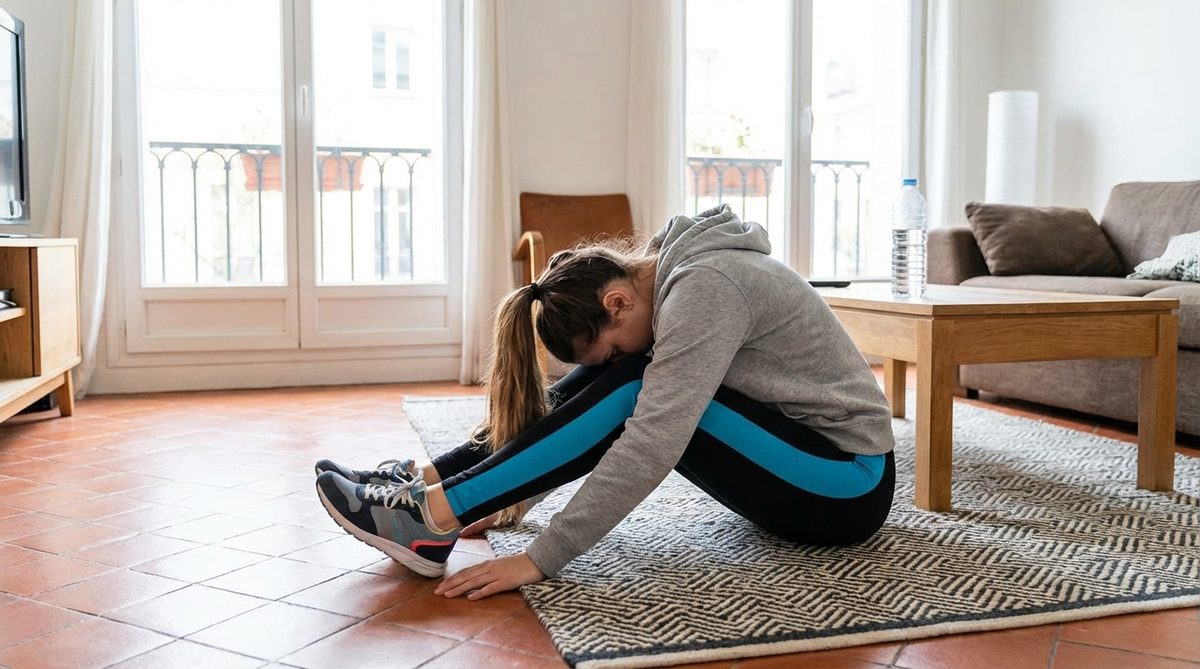
Stop for a moment. Pause your watch. Your average pace will not collapse. Spread your legs slightly for stability. Lean your body forward until your head is really down between your knees. Do not half-ass it. The head should be lower than the heart.
Stay in this position. Don’t move. Count 30 seconds. Breathe calmly.
Be careful when standing. Straighten slowly. Vertebra after vertebra. You should avoid dizziness and a black-out, especially if your heart rate is high. Rushing back to vertical is counterproductive.
Result: Blood flow replenishes the area.
Why does this strange gesture work? When you lower your head, blood rushes to your face and skull. Gravity does the heavy lifting. This blood flow causes the tissues of the head to engorges. This includes the mucous membrane and small fat pads that surround the Eustachian tube.
When these tissues swell with blood, they regain their original volume. They compress the canal.
The valve closes by itself. When you stand up, the echo and resonance disappear. This is a quick and effective hydraulic repair. Finish your workout without feeling like you ran in a scuba suit. The silence returns. The rhythm is back.
This method immediately solves mechanical problems. It does not replace the need for hydration. If this happens often, consider your water intake during exercise. But now that echo is gone. The path forward is clear.
Treating the symptoms is only half the battle. The real win is stopping it from happening two kilometers down the trail. The long-term strategy is simple because the underlying cause is simply loss of mucosal volume due to dehydration. Athletes who are simply rushing to cross the finish line often overlook this.
Prevention tips: Stay hydrated
If you tend to experience this phenomenon, it’s a reliable sign that you’re not drinking enough water during exercise. Or you may already be dehydrated when you start training. To keep the amount of ENT mucous membrane stable, you need to drink regularly, in small sips of water from the beginning of training. Don’t wait until you’re thirsty to drink. Thirst is a late signal.
-Drink a glass of water 20 minutes before you start.
-
If the air is dry, take a water bottle or a canteen with you, for example during 45-minute runs (this is common in March).
-
If you sweat a lot, consider drinking a slightly isotonic drink to increase the tissue’s ability to retain water.
Reassuring note: benign reaction to manage without stress
It is important not to overreact. This is not a serious pathology. This is just your body adapting to stress and water restriction. If this happens, do not stop exercising permanently. Tilt your head back. Let’s drink water. Then continue. This is more of a nuisance, not an injury. Learn to listen to this signal. This is just telling you that your system needs water. When you manage your hydration, you manage your auditory comfort.
Understanding this quirk of the Eustachian tube will help you control of your session. There is no reason to panic. The next time you’re feel that resonance, remember that a change of perspective and a little gravity can be enough to bring things back to normal.


