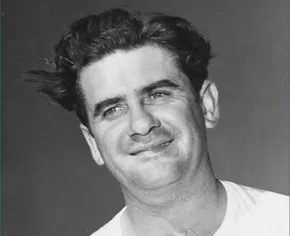
Elzie Wylie Baker, known to the racing world as “Buck,” was the kind of driver who didn’t just race cars. He hunted them. In the rough-and-tumble Modified division of the 1950s, he was a high-speed specialist with a reputation that preceded him into the pits. He won races. He won arguments. He compiled an enviable record in post-race fisticuffs because, frankly, if you laid a bumper on him, you were signing up for a fight he wouldn’t lose.
Baker wasn’t just a one-trick pony. He was active across the entire NASCAR tree during the progressive 50s. He split time between tumultuous short tracks and the high-stakes NASCAR Grand National circuit. He even took time off to win the championship for the Speedway Division tour in 1952, a short-lived open-wheel venture that proved his versatility. Team owners loved him. He was a sought-after pilot when he wasn’t behind the wheel of his own machinery.
Then came 1955.
Carl Kiekhaefer entered the NASCAR touring series and effectively cleaned house. His team won 22 of the 39 races. The other “shade-tree-engineered” teams got scraps. But Kiekhaefer noticed something. Baker was giving the Mopar factory team a serious run for the money. He was driving self-owned Oldsmobiles and Buicks that held their own against the might of Chrysler.
“I saw that Buck was my top competition,” Kiekhaefer said at the start of the ’56 season. “There is only one thing to do with a man like that — hire him!”
The strategy worked. Baker won his first start with Kiekhaefer in a 150-mile dirt track event in Phoenix. It set the tone for everything that followed. He won 14 races in 1956. He finished in the top five 30 times out of 48 starts. He captured the Grand National title.
“My dad won his share of races on the track, but I don’t think he ever lost a battle in the pits.”
When Kiekhaefer suddenly quit NASCAR after the 1956 season, Baker didn’t miss a beat. He moved to a factory-supported Chevrolet under the direction of Hugh Babb. The hot streak continued. He won 10 races. He only finished out of the top ten twice in 40 starts. He took his second straight national driving championship.
In those two title years alone, Baker won 24 of his 46 career Grand National victories. That is efficiency. That is dominance.
His legacy is cemented by three wins in the storied Southern 500 at Darlington. The first came in 1953. He was driving an Oldsmobile owned by T.C. Griffin. He scampered past a fading Herb Thomas in the closing stages.
The second win in 1960 was pure drama. Jack Smith refused to drive at Darlington after a terrifying aerial chiller in the ’58 race. Baker filled in for Smith. He wheeled Smith’s Pontiac to victory. He finished the race on three wheels, throwing up a shower of sparks after blowing a tire with only two laps remaining.
His final superspeedway triumph came in 1964 at Darlington. He was driving a Dodge for master mechanic Ray Fox. He was 45 years old. He proved he hadn’t lost the edge. It turned out to be the final win of his Grand National career.
Baker was a chameleon. He won races in eight different makes of cars: Hudson, Oldsmobile, Buick, Chrysler, Chevrolet, Ford, Pontiac, and Dodge. He also won for eight different team owners: B.A. Pless, T.C. Griffin, Ernest Woods, Kiekhaefer, Babb, Smith, Fox, and himself.
“There is only one thing to do with a man like that — hire him!”
He retired as a full-time driver after the 1968 season. He didn’t stop racing. He moved to the pony league Grand Touring Series, featuring Mustangs and Camaros. He won eight times in four seasons.
But the old habits die hard. After kicking around short tracks in the Carolinas, Baker got restless. He wanted big-league waters again. In 1976, he struck a deal with team owner Junie Donlavey. He returned to Darlington for the April 11 race. He qualified 13th. He finished sixth. Not bad for a battle-weary 57-year-old veteran.
During his career in NASCAR Grand National racing, Elzie Wylie Baker competed in 636 races. He won 46 times. He was the first driver to exceed $300,000 in official career earnings.
He didn’t just survive the 1950s. He defined them. And if you were on his bumper, you probably regretted it.