Dana White isn’t just running the show at the Ultimate Fighting Championship (UFC) ; he’s selling it as the pinnacle of athletics. He’s seen the NBA Finals. He’s sat courtside at Super Bowls. He’s watched title fights in Las Vegas. And he’s convinced that nothing else compares. According to the UFC president, the Ultimate Fighting Championship (UFC) stands alone at the top of the sporting world.
It’s a bold claim for an organization that nearly went bankrupt in the late 1990s. The UFC reinvented itself from a brutal spectacle into the premier Mixed Martial Arts (MMA) promotion we see today. But to understand why fans flock to the octagon, you have to look past the hype and into the rulebook. The structure is familiar to boxing fans but significantly more complex.
The Mechanics of the Octagon
UFC events feature a slate of bouts, each a one-on-one contest between two competitors. Like boxing, these matches are divided into timed rounds under the watchful eye of a referee. But the similarities end there.
Standard UFC bouts are limited to three rounds. Championship fights go the distance for five. Each round lasts five minutes, with a one-minute rest period in between. In boxing, you’re restricted to using your fists above the belt. The Ultimate Fighting Championship (UFC) throws that constraint out the window.
Here, fighters can use punches, kicks, elbows, and knee strikes. Takedowns and submissions are fair game. Strikes are legal both above and below the belt, with very few exceptions. The early days of the UFC sold a fantasy of no-holds-barred (NHB) fighting. That label is misleading. Even in the beginning, there were rules.
Athletes were expected to follow a basic code of conduct. You couldn’t gouge your opponent. No fish hooking—using fingers to hook the mouth. Groin strikes were banned. These were the bare minimums.
Fouls and Consequences
Today, the Nevada State Athletic Commission regulates all combat sports in Nevada. They have identified 31 distinct fouls. Violating one can lead to point deductions, disqualification, or other penalties.
The list isn’t just about violence. Holding the cage is a foul. Using abusive language inside the octagon is a foul. Faking an injury to stop the fight is a foul. Dropping your mouthpiece intentionally to buy time is a foul. The UFC website publishes the complete list, but the intent is clear: discipline matters.
Drug testing is another strict layer of the operation. The organization adheres to the Nevada State Athletic Commission’s drug policy, which bans both recreational and performance-enhancing substances. A fighter who tests positive before a bout is barred from competing. If a winner is later found to have used banned substances, the result can be overturned to a no contest.
The rules keep getting refined. The violence is still there, but it’s packaged in a way that protects the athletes and the sport. It’s why the UFC has survived. It’s why Dana White thinks it’s the best sport on earth.
The basics are set. The rules are clear. Next, we’ll look at where these fights actually take place and what makes the venue part of the spectacle.

The UFC doesn’t use a ring. It uses the Octagon.
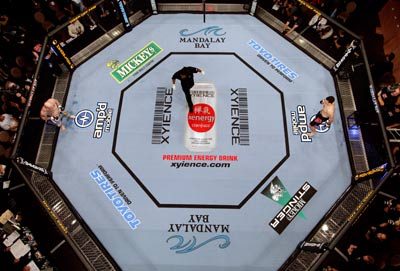
You can guess the shape from the name. Eight sides. An octagonal cage. The structure stands thirty feet across. Walls are built from fencing material. Pads cover every edge. Every corner is padded.
The floor is canvas.
This mat is custom painted for each event. It is never used again. Two gates provide entry. They are locked shut at the start of every round.
Inside, only two people fight. And the referee.
That’s it. No one else enters while the action is live.
Between rounds, the gates open. Corner men rush in. They bring water. They bring ice. They give tactical advice. They also patch up cuts and scrapes to stop bleeding.
The Octagon is an eight-sided octagonal mat and cage.
This setup isolates the fighters. It forces engagement. There is no rope to hide behind. No corner to stall in. Just eight walls. And the canvas that gets thrown away after every fight.
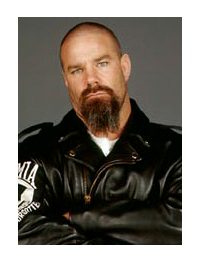

The cage isn’t just a boundary; it’s a strategic tool. Fighters aren’t allowed to leave the Octagon during a bout. You can’t try to heave your opponent over the top, either. Tank Abbott tried to throw Carl Worsham over the fence in a past UFC bout. It looked ridiculous. It didn’t work. The rules are clear: stay inside.
But why an eight-sided cage? Dana White has explained this many times. The original UFC idea was simple. Match styles against each other. See which martial art dominates. Different fighting styles prefer different spaces. Boxing uses a square ring. Wrestling uses a circle. The Octagon removes the advantage of any specific corner geometry. The angles are wider than a boxing ring’s corners. A fighter can’t get trapped with no escape route. The fencing keeps them in. It’s stable. It’s safe. It gives spectators a clear view.
There is no official ranking system in the UFC. Each weight class has a champion, but that’s where the structure ends. Dana White says rankings get in the way. They complicate matchmaking. They invite corruption. Instead, Joe Silva, the vice president and matchmaker, runs the show. He uses his own system. He looks at styles. He checks records. He finds the most exciting fights. Prove yourself enough. Earn a title shot. That’s the path.
Understanding UFC Weight Classes
The UFC recognizes five weight classes. Fighters stay in their own class. Moving up or down is allowed, but it comes with trade-offs.
- Lightweight: 145 to 155 pounds
- Welterweight: 155 to 170 pounds
- Middleweight: 170 to 185 pounds
- Light Heavyweight: 185 to 205 pounds
- Heavyweight: 205 to 265 pounds
Gaining weight to move up usually costs speed. Dropping weight often means losing striking power. It’s a constant balancing act.
Fighting Techniques
Fighters use three main categories of techniques. Striking. Grappling. Ground fighting. Let’s break them down.
Striking


Striking isn’t just about throwing punches. It’s a layered system of kicks, knees, and elbows. Fighters often pull from a bag of disciplines, blending the footwork of boxing with the lethal clinch work of Muay Thai. But in the Octagon, the rules are strict. You wear fingerless gloves weighing between 4 and 6 ounces. No shoes.
This is a stark contrast to boxing gloves, which tip the scales at 8 to 10 ounces depending on the weight class. The UFC mandates these thinner gloves for a reason: they offer less protection. You have to be careful. Throw a punch with too much force or poor alignment, and you’ll shatter your own hand before you hurt your opponent.
There are hard lines you cannot cross. You can’t kick or knee a grounded opponent in the head. You can’t hammer down with the point of your elbow. And the back of the head? Off-limits. Protecting the brain stem and the skull’s base is non-negotiable in modern MMA.
The Art of the Takedown
Some guys live on the ground. They prioritize grappling over striking, spending hours drilling how to drag an opponent into hell. A takedown is the gateway. You force them down. They want to stay standing, so they sprawl. That’s leverage and balance used to keep your hips low and your back flat, stopping the shot cold.
Takedowns can be spectacular. Watch a slam or a suplex and you see physics in motion. Other times, it’s ugly. Just a shove, a loss of footing, and suddenly you’re staring at the canvas.
Once you’re on the mat, the game changes. Submission holds are the weapon of choice. A guillotine choke can end a fight before the ground is even touched. Most of these holds require both bodies to be horizontal, pinning the neck or limb. But don’t get it twisted—standing submissions exist. A fighter can lock in a choke from their feet if they’re quick enough.
Ground Fighting
When the dust settles and everyone is on the floor, the objective shifts entirely. It’s no longer about who can hit the hardest. It’s about position. It’s about control.
The person on top holds the power. They dictate the pace. They can strike. They can advance. The person on the bottom? They’re defending. They’re scrambling. They’re looking for an angle to reverse the position or slip into a submission.
Ground fighting is a chess match played with limbs. You guard. You shield. You frame. You wait for a mistake.
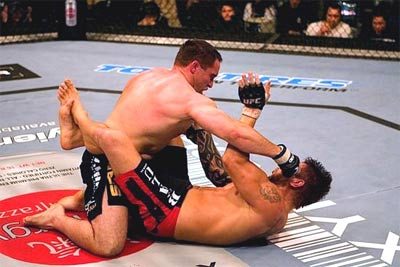

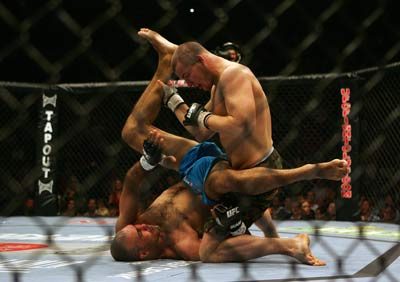
Striking is only half the battle. Once bodies hit the canvas, the game changes entirely. Unlike boxing or standard kickboxing, where a knockdown often signals a pause or a specific count, MMA fights continue with brutal efficiency on the mat. Fighters can unleash ground and pound —strikes delivered from a dominant top position—or attempt to lock in submission holds that force an opponent to quit.
Positioning is everything down there. You’ll hear commentators throwing around terms like guard, half guard, side control, and full mount constantly. These aren’t just fancy words; they describe the specific geometric relationship between two bodies. If Fighter A is on their back and has their legs wrapped around Fighter B’s hips, Fighter B is trapped inside Fighter A’s guard. It’s a defensive shell designed to prevent strikes and set up sweeps or submissions.
To survive and thrive in the UFC, you can’t just be good at one thing. You need to train extensively across all three pillars of the sport: striking, wrestling, and grappling. Sure, most fighters have a preferred style. You’ve got strikers who want to keep it standing and grapplers who drag you into deep water. But even the best pure striker needs a basic working knowledge of takedown defense, and the elite wrestler needs to know how to survive if they get caught in a submission. Specialization wins fights, but versatility wins championships.
How Judges Determine the Winner
So, if no one taps out and no one is knocked out cold, how do they decide who goes home with the belt? It comes down to the judges’ scorecards, and understanding how UFC matches are scored is essential for truly following the sport.
Most championship bouts go the distance—five rounds of fifteen-minute chaos. Judges score each round individually using the 10-Point Must System. The winner of the round gets 10 points. The loser gets 9, or fewer, depending on how dominant the victory was. A round where one fighter is clearly hurt, rocked, or significantly outclassed might result in an 8-10 score.
What actually counts toward that 10? It’s not just about who threw more punches. It’s about effective aggression and octagon control, but mostly it’s about damage and control time. If you spend four minutes on top of your opponent, landing clean shots while they’re trying to escape, you’re winning that round. If you take someone down, keep them there for the whole round, and they can’t get up, that’s control.
But here’s the nuance that trips up casual fans. Effective striking doesn’t always beat grappling if the grappling is dominant. A fighter might land three beautiful knees but spend the other 4:30 of the round being smothered in their opponent’s guard, unable to move. Most judges will still award the round to the person controlling the position and landing meaningful strikes. It’s about who had the greater impact on the physical and mental state of their opponent.
Sometimes, a fight ends in a draw. It’s rare, but it happens. A majority draw means two judges scored it even while the third had a winner. A split draw is even rarer, meaning the judges completely disagreed on the winner of the round. But in modern MMA, with stricter scoring criteria, draws are becoming less common.
How UFC Fights Actually End
You can throw punches. You can twist limbs. But ultimately, how do you secure the win? It usually comes down to two specific outcomes that define the end of a bout.
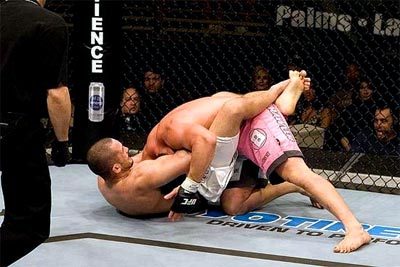
Submission victories are the most direct. They happen when an opponent physically taps out or verbally concedes. Maybe they got crushed by strikes. Maybe they’re trapped in an armbar or an ankle lock that feels like their limb is snapping. There is also the classic rear naked choke. This isn’t just pain; it cuts off the air supply or, more dangerously, blood flow to the brain. You can literally knock someone out with a hold.
In other combat sports, quitting might mean career suicide. Here? It’s honorable. It’s part of the game. You tap. You lose the round, but you keep your neck intact.
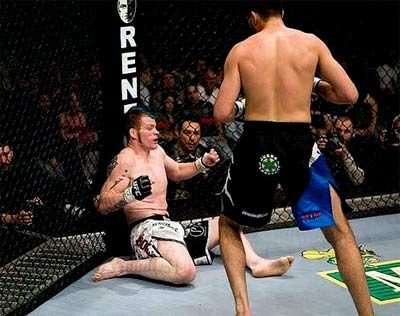
Then there is the technical knockout (TKO). This is when the referee steps in. They decide the fighter can no longer defend himself intelligently. It’s not about how much damage you’ve taken. It’s about your ability to protect your head from incoming strikes. Referees have to make split-second calls in chaotic, high-speed environments.
Unlike boxing, there is no “standing eight count.” You don’t get a moment to breathe on the ropes. If the ref sees you’re done, the fight is over. Whether you’re on your back or standing on your feet, the bell rings. The TKO is the stoppage that saves a fighter from further harm, even if it looks brutal.

When the final bell rings and nobody taps out, nobody gets knocked unconscious, the outcome falls to three judges. They use the 10-point must scoring system. It is simple in theory but messy in practice. The winner of a round gets 10 points. The loser gets nine or less. Penalties for fouls, inactivity, or timid defense usually drop a fighter’s score below a nine.
Judges add up the totals at the end. If all three cards favor one fighter, it is a unanimous decision. If two judges pick one fighter and the third picks the other, it is a split decision. If two judges pick one fighter and the third calls it a draw, it is a majority decision.
You can also win without a decision. A technical decision happens if an injury stops the fight and the opponent cannot continue. Referees can award a win via disqualification if an opponent breaks the rules. A forfeit also counts as a win, usually because the opponent is hurt or sick and steps away.
Draws are possible too. A standard draw occurs when judges’ scores are tied or cancel out. A technical draw happens if both fighters are too injured to proceed. A no contest is declared if both fighters foul each other or if one is hurt by an illegal move and cannot continue.
This complexity makes UFC bouts thrilling. A fight can look one-sided while standing but shift completely on the ground. Fighters turn tables with escapes or by exploiting mistakes. It is rarely over until it is over.
Scoring Ground Game vs. Striking
UFC fights are more complex than boxing. Judges weigh more than just strikes. They look at takedowns, ground control, and damage.
Being on the bottom is usually weaker. Top position dominates. But some fighters defend so well from the back that a judge might award them the round. It happens.
Dana White addressed the judging controversy directly. He admitted it is subjective. The main goal is to see who did the most damage. Round by round, that is the metric. But damage is hard to quantify. It leaves room for argument.
If you want to understand the judging better, focus on who landed the cleaner strikes. Who controlled the pace? Who survived the ground game? It is not always clear.
The Controversy Behind the Scorecards
Judging remains a hot topic. Fans argue about every split decision. They question why one fighter’s damage outweighs another’s. It is subjective by nature. There is no perfect formula.
Dana White says judging is controversial. He points to the difficulty of evaluating damage. Some judges prioritize volume. Others look for control. It depends on the individual.
This subjectivity fuels debate. It keeps fans engaged. It makes every decision feel personal. Is it fair? Sometimes. Is it perfect? Never.
The history of judging in the UFC is long. It is filled with debates. It will continue to be debated. That is part of the sport.
For more insights on sports performance and analysis, check Sharecare.com.
UFC History
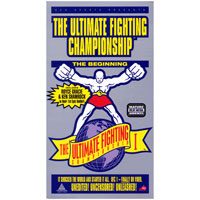
It started with a specific vision. Rorion Gracie didn’t want to sell tickets for a show. He wanted to prove a point. As an expert in Brazilian jiu-jitsu, he believed in techniques that survived real combat, not the flashy moves designed for style. He and ad man Arthur Davie teamed up to promote the Gracie family’s martial arts school, a place where efficacy trumped aesthetics.
The family had a reputation built on the Gracie Challenge. It was an open dare: any martial artist could step in and try to beat a Gracie or their student in a no-rules fight. They had already established themselves as legends by winning these bouts. Now, they wanted to scale that up.
Davie took the pitch to the Semaphore Entertainment Group (SEG). His idea was simple: a tournament. Experts from every discipline would clash to see which style ruled the ring. Who came up with the name? The Ultimate Fighting Championship reportedly belonged to SEG employee Michael Abramson. It stuck.
On November 12, 1993, SEG debuted the first event. We know it now as UFC 1.
The Tournament Structure
This wasn’t a lineup of separate fights. It was a bracket.
Win a match, and you advanced. Lose, and you were out. Davie added alternates to the roster, a practical move in case a fighter got injured or couldn’t compete. The field was diverse. You had karate masters. Kickboxers. Boxers. Jiu-jitsu practitioners. Even a Sumo wrestler.
Royce Gracie, Rorion’s younger brother, stepped into the cage. He didn’t overpower his opponents with size or speed. He used leverage. He used technique. In the final bout, he locked a rear naked choke on Gerard Gordeau. Gordeau tapped. Royce won the tournament.
A New Brand is Born
The event worked. SEG saw the potential immediately. They didn’t want to experiment with new names or formats. They kept the Ultimate Fighting Championship branding. Future events would simply be numbered. UFC 2. UFC 3. The legacy had started, and the numbering system set the stage for everything that followed.

The Rules of Engagement
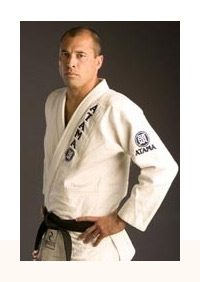
The early days of the UFC were a chaotic free-for-all. No weight classes meant a lightweight grappler could be forced into a cage with a heavyweight sumo wrestler. Fighters were allowed to wear their traditional gear, meaning you’d see gi s on the mat. Rounds had no time limits in some events. The goal was simple: fight until someone tapped out or the ref waved it off.
Royce Gracie dominated this era, winning three of the first four tournaments. His success proved one thing: ground fighting wasn’t just an option; it was mandatory. Fighters who relied solely on striking struggled. They had to learn wrestling and submissions to survive. The myth of the black belt crumbled quickly. A high rank in a traditional martial art didn’t guarantee a win in the octagon.
Referees had little power. For a while, their only job was to enforce a handful of rules and watch for submissions. They couldn’t stop fights. It took a few events before the UFC gave referees the authority to step in and save fighters from themselves.
Most events used a tournament bracket. Fighters faced multiple opponents in one night. That changed after UFC 18. Single matches became the standard, sparing competitors from exhausting themselves with back-to-back bouts.
Dana White later admitted the UFC’s growth was accidental. The first event was a one-off experiment. It performed well on pay-per-view. So they did another. And another. No one predicted a sport would emerge.
SEG’s Financial Woes
As critics piled on, the UFC tried to clean up its image. New rules were introduced to appease politicians and legitimize the sport. By then, Ultimate Fighting Championship LLC (SEG) was drowning in debt. From UFC 23 to UFC 29, SEG hovered on the brink of bankruptcy. They couldn’t even afford to release these events on home video.
SEG marketed the UFC as brutal. “No holds barred” was the slogan. They promised a clear winner and a superior style would rise. This marketing strategy backfired. It invited scrutiny from people who hated what they saw.
Senator John McCain led the charge. He called the fights “human cockfighting.” He pressured state governors to ban the events. Venues canceled bookings at the last minute. The UFC refused to work with athletic commissions for years. They wanted to keep the “primal” image. It didn’t work. Cable companies dropped the pay-per-view broadcasts. SEG’s options vanished. By the time they adopted rules from the New Jersey Athletic Control Board, the damage was done.
Zuffa Takes Over
In 2000, SEG produced UFC 29: Defense of the Belts. It was their last. Political pressure and financial ruin had crippled them.
Two brothers, Frank Fertitta III and Lorenzo Fertitta, saw an opportunity. They formed Zuffa, LLC. “Zuffa” means fight in Italian. They bought the UFC. Dana White, a former amateur boxer and promoter, became president.
Lorenzo Fertitta knew the system. He was a former member of the Nevada State Athletic Commission. Soon, Nevada oversaw UFC events. This gave the organization credibility. Cable companies started carrying pay-per-views again. The sport had a second chance.
But the road ahead was still rocky. The public still saw violence. The fighters were still unrecognizable to most fans. Zuffa had to prove this wasn’t just brawling. It had to be a sport.

The early 2000s were a pivot point for the UFC. Before The Ultimate Fighter, the sport was a niche curiosity. After it, the UFC became a household name. The shift didn’t happen overnight. It started with structural changes in distribution and ended with a cultural reset on reality television.
From Pay-Per-View to Cable Dominance
The business model shifted in 2001 with UFC 30: Battle on the Boardwalk. This was the first event promoted by Zuffa. It marked a return to wider pay-per-view coverage. It also revived home video production for the organization.
Dana White took over with a clear mandate. He wanted to shed the sport’s “barbaric” image. He needed to prove these athletes weren’t just brutal fighters. They were competitors. White often noted that these men were good people. They entered the octagon to determine who was the best fighter in the world.
But pay-per-view had a ceiling. You could only sell so many bundles to hardcore fans. The UFC needed mainstream appeal. They needed to reach people who didn’t own a TV guide subscription.
The Reality TV Catalyst
That solution arrived in 2005. Spike TV aired the first season of The Ultimate Fighter.
The concept was simple. A group of UFC hopefuls lived together. They divided into two training camps. Each week, a member from one team fought a member from the other. The winner stayed. The loser went home.
This format did two critical things for the organization.
First, it educated viewers. People who didn’t understand the rules or the techniques finally got context. They saw the training. They saw the drama. They saw the sport’s human side.
Second, it broke the pay-per-view barrier. For the first time, fans could watch a UFC fight on a cable station. This wasn’t a niche broadcast. It was prime-time entertainment. The exposure was massive.
Sustaining the Momentum
The show’s success wasn’t a fluke. It established a new model for talent acquisition and marketing. The UFC didn’t just air fights. They created narratives. They built stars through elimination matches.
The success of the first season guaranteed longevity. The network committed to at least two more seasons. This secured a pipeline of new fighters. It also kept the UFC in the public eye between major pay-per-view events.
The strategy worked. The UFC grew from a fringe sport to a global brand. The reality TV model provided the platform. The fighters provided the content. The result was an organization that could no longer be ignored.
What happens when the reality show ends? The fights continue. The stakes just get higher.

The Global Expansion of Mixed Martial Arts
The Fertitta brothers bought Pride Fighting Championship back in March 2007. That purchase changed the landscape of combat sports. Suddenly, the dream of a true superfight between the best Pride stars and the top UFC talents wasn’t just a fantasy. According to UFC President Dana White, it was becoming a concrete plan. We were looking at a potential merger of styles and titans that had been separated by ocean and culture.
But the UFC wasn’t just looking across the Pacific. They were looking everywhere. The headquarters sit in Nevada, but the ambition was global. White launched a campaign to take the spectacle out of Las Vegas. The goal was simple: build a grassroots fan base where it matters most.
“When you take the live event somewhere and you get 15,000 or 20,000 people to show up to the event and those people leave the event and go to work the next day, they talk to their relatives. They talk to their friends. It starts to spread…that whole word of mouth thing happens, and it’s imperative for the growth of the business and to take it global.”
This strategy wasn’t about broadcasting to 170 countries on TV. It was about getting bodies in seats. European arenas. Japanese domes. Canadian and Canadian crowds. You can’t replicate the energy of a live crowd digitally. The word-of-mouth engine only starts when people are there in person, screaming until their voices give out.
Access and Availability
For the average fan, seeing the action was already easier than ever. Pay-per-view broadcasts ran about once a month. Spike TV carried “The Ultimate Fighter” and “Fight Night” specials. DVDs filled shelves. But there was a gap. Events 23 through 29 remained stuck in obscurity, unavailable for commercial purchase. If you missed those fights live or on TV, you were out of luck. The archive wasn’t complete.
Breaking Down the MMA Landscape
If you are new to the sport, or just need a refresher on the business side, here are the essentials.
The Cost of Admission
How much does it cost to go to a UFC fight? The average ticket price hovers around $208. That’s not cheap. But if you know where to look, tickets can start as low as $64. It depends entirely on the event and the location. Early prelims in smaller markets? Cheap. Main events in Madison Square Garden? Expensive.
The Wealth Gap
Who is the richest UFC fighter? As of this writing, Conor McGregor holds the crown. His estimated net worth sits at $120 million. That number includes fight purses, but mostly it comes from endorsements. McGregor turned fighting into a brand. Most fighters are still fighting for the belt. He’s fighting for the bank account.
Where to Watch Live
Where can I watch UFC events live? Mostly via pay-per-view. The UFC website offers streaming options. ESPN+ has become the primary home for these events in the US. You pay a subscription, or you pay per event. There is no free tier for the big shows.
What Exactly is MMA?
MMA stands for mixed martial arts. It’s a hybrid combat sport. It pulls techniques from boxing, wrestling, judo, jujitsu, karate, Muay Thai, and more. It’s not just brawling. It’s a strategic mix of striking and grappling. The most complete fighter wins.
Is It Illegal?
Why is MMA illegal? It isn’t. It’s actually one of the fastest-growing sports in the U.S. The UFC popularized it on a massive scale. They introduced legions of fans to the chaos. The bans are gone. As recently as 2016, states like New York lifted their previous prohibitions. The sport is legitimate now. The stigma is fading.
The integration of Pride talent would have been the final piece of the puzzle. A unified front. But the expansion into international markets kept the momentum going. The grass roots took hold. The word spread.
For more on how these fighters operate, you can look into how boxing works, or how karate evolved. The history of the UFC is documented in sources like “No Holds Barred” by Clyde Gentry. The Nevada State Athletic Commission still regulates the bouts. Sherdog and MMAFighting.com track the stats. The sport is here to stay. It’s bigger than a fight night. It’s a global phenomenon.