You finished a brutal upper-body session. You’re sore, sure, but functional. You go to bed.
The next morning, your shoulder blade feels like a rock. You rub it. There is a hard, tender lump under the skin. Moving it triggers a sharp, spasming pain. It feels like you are poking a gumball buried deep in the tissue.
After a few days of stretching, heat, and patience, the tightness fades. The shoulder returns to normal.
You want to avoid this next time. But what exactly was that knot?
Muscle Knots Explained
I am an exercise physiologist. My job involves studying how different movements stress muscle tissue. The goal is simple: help people perform better. This means optimizing preparation and recovery, not just the workout itself.
The most frequent question I receive from clients and readers involves muscle knots.
People want to know two things immediately.
First, what are they?
Second, how do you get rid of them?
Most people assume the knot is actual clumped muscle fibers. That is a myth. Muscle tissue does not clump into balls.
Current research suggests these knots are hyperirritable spots within a taut band of skeletal muscle. The tissue is compressed. Blood flow is restricted. The nerve endings in that area become overly sensitive.
This sensitivity causes the pain. It also causes the reflexive tightening. The body tries to protect the area by contracting the muscle further. This creates a cycle. Tightness leads to pain. Pain leads to more tightness.
Understanding this mechanism is key to treating muscle knots effectively. You cannot simply “break up” a muscle fiber. You have to address the tension and the sensitivity.
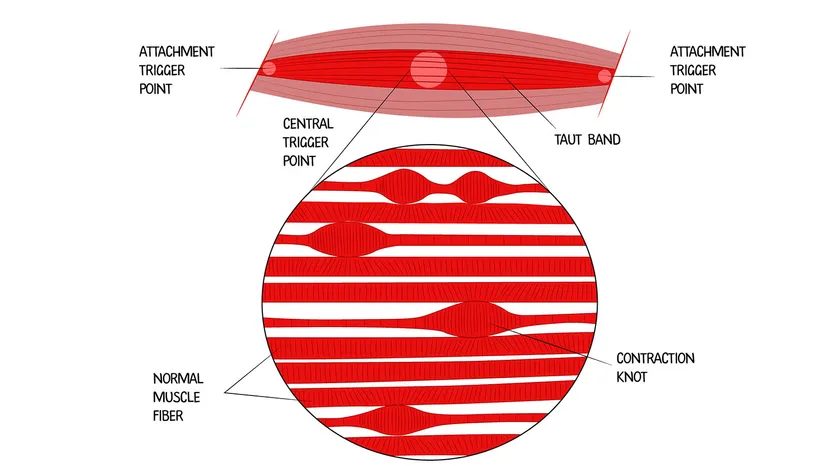
The lumps you feel deep inside your muscle tissue. They range from the size of a marble to something closer to a golf ball. Medical professionals call these myofascial trigger points.
The name tells you exactly what is happening. “Myo” refers to muscle. “Fascial” refers to the thin connective tissue sheet that wraps around each muscle fiber. When that tissue gets irritated, it tightens up. You end up with a knot.
This isn’t just a bad cramp. It is inflammation. Even minor damage to muscle fibers can cause swelling in both the muscle bands and the overlying fascia. That clump of inflamed tissue becomes tender. It restricts your range of motion. Moving the affected limb can trigger sharp pain.
These knots do not show up on standard medical imaging. X-rays and MRIs cannot detect them. Researchers are still debating the exact physiological mechanisms that cause this localized reaction. We know they form when a muscle is stressed by repetitive motion. Usually, this happens when you introduce a new activity or increase the intensity.
Think about your workout routine. If you lift weights every week but suddenly add running, your body reacts. You are asking your calves to perform a movement they are not used to. The result? Knots. The new stress causes micro-damage and subsequent inflammation.
You do not need a gym membership to get them. Poor posture is a major culprit. Sit at a desk all day with your shoulders hunched forward. You hold that static position for hours. The muscles in your upper back and shoulders are under constant tension. They fatigue. They tighten. The knot forms.
What Causes Myofascial Trigger Points?
The primary cause of these trigger points is mechanical stress. Your muscles are not designed to stay locked in one position for long periods. Neither are they always equipped to handle sudden spikes in load.
Consider the difference between dynamic movement and static posture. Running involves repetitive flexion and extension. It builds heat. It demands adaptation. When you do something strenuous that your body hasn’t adapted to yet, the local tissue reacts. The fascia thickens slightly. The muscle fibers contract involuntarily to protect the area. That contraction is the knot.
But static positions are just as damaging. When you sit at a computer, your anterior muscles (chest and shoulders) shorten. Your posterior muscles (upper back) stay elongated and weak. Gravity pulls your head forward. The strain accumulates. You might not feel it immediately. Days later, you reach for a mouse and feel a sharp pinch in your shoulder blade. That is a myofascial trigger point responding to hours of poor ergonomics.
How to Tell If You Have a Trigger Point
Identifying these knots is usually straightforward because of the symptoms. They are tender. Press on them and you will feel a specific spot of discomfort. It may radiate pain to other areas. This is called referred pain.
The limitation of movement is another key indicator. Try to stretch the affected muscle. If you hit a hard wall of pain or restricted range before a full stretch is achieved, you likely have a knot.
Researchers are still working out the exact cellular processes. But the practical observation is clear. Irritation leads to inflammation. Inflammation leads to tightness. Tightness feels like a lump.

How Long Do Muscle Knots Take to Heal?
Most of the time, the best cure is patience. You just have to wait. It takes time for your muscles to adapt to a new motion or recover from the stress that caused the knot in the first place. Usually, within a week or two, the muscle knot resolves on its own. No intervention required.
If you want to speed up the clock, there are professional routes. Some people opt for massages. Others try dry needling, which involves injecting a very thin needle into the trigger point. The goal is to break up some of the tissue and increase blood flow to the area. Electrical stimulation is another option.
The common denominator in all these treatments is the same. They aim to decrease the tautness of the fascia and muscle in the affected area. More blood passing through provides nutrients and oxygen to the damaged tissue. This enhances recovery.
But those methods cost money. They require appointments. There are more cost-effective things you can do yourself at home. A fairly simple way to help alleviate muscle knots is stretching.
Stretching may be particularly valuable if you typically sit in an awkward position all day long. Muscles held in that way under consistent stress for several hours benefit from being put through different ranges of motion.
Consider your posture after hours at a desk. Some simple shoulder rolls and neck rotations can alleviate some of the tension in those muscles. It helps avoid or reduce the accumulation of muscle knots before they become a real problem.
What Is Self-Myofascial Release?
Another method you can try at home is called self-myofascial release. The idea behind it is the same as massaging. Except this method can be done in the comfort of your own home. You need a foam roller, a rolling device, a hard ball like a lacrosse ball or softball, or even a small piece of PVC pipe.
Let’s say you have knots in the quadriceps muscle group on the front of your thigh. You lie on a foam roller. You gently roll your leg back and forth on it. Alternatively, you can roll the device up and down the muscle group. Keep the pressure within your comfort range.
Because you apply as much pressure as you like, you’re able to work within your own pain tolerance. This is a significant benefit. Alleviating myofascial trigger points can be uncomfortable. You control the intensity.
You can use this technique across the body anywhere you have muscle knots. It’s flexible. It’s accessible.
When to See a Doctor for Muscle Knots
While they can be annoying, muscle knots are nothing to worry about. They are a minor annoyance, not a medical emergency. But what if they don’t go away?
If a knot persists for longer than a few weeks despite self-care, or if it is accompanied by numbness, tingling, or weakness, it might not be a simple muscle knot. It could be nerve compression or another underlying issue. In those cases, professional evaluation is necessary.
Remember, being consistent with exercise habits and moving throughout the day can help keep knots from developing in your muscles in the first place. If you do notice muscle knots popping up, simply stretching at the end of the day or going through some self-myofascial release techniques are simple, effective ways to help alleviate this issue.
It’s about maintenance. Your body is a machine. It needs lubrication. It needs movement. Ignore it, and parts will wear out. Treat it well, and it keeps running.
There is no magic bullet. Just consistent care. And sometimes, just waiting for the body to fix itself.

The Hidden Mechanics of Child Strength
Zachary Gillen spends his days at Mississippi State University figuring out what happens inside a young body when it moves. He is an assistant professor of exercise physiology. His work doesn’t just look at how fast a child runs. It digs into the machinery.
Muscle strength. Neuromuscular function. Exercise metabolism.
These are the pillars of his research in pediatric exercise science. Most people think of kids as small adults. They aren’t. The biological processes are different. Faster. More plastic.
Gillen’s work helps correct that assumption.
Why Muscle Matters in Youth
The common misconception is that kids don’t need strength training. They just need to play. That’s incomplete.
Neuromuscular function develops through movement. It’s not just about building bulk. It’s about communication between the brain and the muscle. When a child lifts a weight or performs a plyometric exercise, they are teaching their nervous system to fire more efficiently.
This matters for long-term health.
Stronger muscles support better joint stability. They improve metabolic rate. They lay down a foundation for adulthood.
The Metabolic Advantage
Children’s bodies process energy differently. Gillen’s research highlights exercise metabolism in youth. Their mitochondria are highly responsive. This means they can adapt to physical stress quickly.
But it also means they need the right stimulus.
Too little activity leads to poor metabolic conditioning. Too much, too soon, with poor technique, leads to injury. The balance is tricky.
Gillen’s focus is on that balance. How much is enough? How should it be structured?
Breaking the Stereotype
There is still a stigma around young people lifting weights. People worry about growth plates. About stunted growth.
The evidence doesn’t support those fears when done correctly. Proper supervision and technique are non-negotiable. But avoiding resistance training entirely isn’t the answer either.
It’s about quality.
A child who learns to control their body weight, then adds external load, builds a resilient frame. They learn proprioception. They learn confidence.
Looking Forward
Gillen’s work is part of a larger shift. We are starting to take pediatric fitness seriously. Not as a sideline. As a core component of health.
The data is accumulating. The methods are refining.
The goal isn’t to make child bodybuilders. It’s to make healthier adults. The path starts early.
It starts with understanding how a young body works. And how it responds.
The details matter.