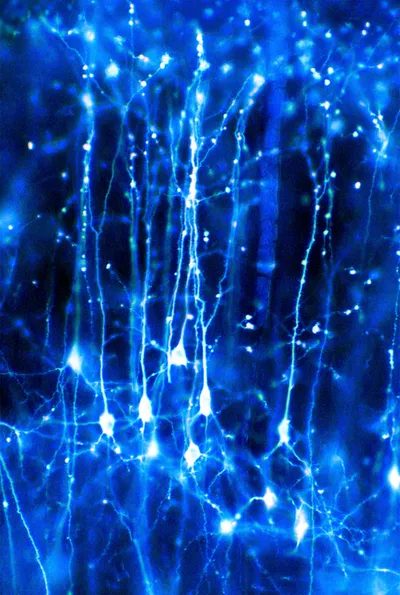
You think about them. They think about everything else.
The neuron is the basic cell of the nervous system. It shows up in vertebrates. It shows up in most invertebrates. You find it in organisms as simple as cnidarians. Corals. Jellyfish. Then it gets highly specialized in more complex animals. Humans included.
These cells handle the heavy lifting of your existence. They receive information. They process it. They transmit data. They do this through electrical and chemical signals. This mechanism enables functions ranging from basic reflexes to complex thought.
the electrical spark
Neurons are responsible for receiving, processing, and transmitting information through electrical and chemical signals.
How does it work? It starts with electricity.
A signal travels down the length of a neuron as an electrical impulse. It’s fast. It’s direct. It allows you to pull your hand away from a hot stove before you even realize it’s hot. That’s a reflex. Simple. Fast.
But it doesn’t stop there. The electrical signal has to cross a gap to get to the next cell. That’s where chemistry takes over. Neurotransmitters jump the synaptic cleft. They bind to receptors on the receiving neuron. The process repeats.
This chain reaction builds into something more.
from reflex to thought
Basic reflexes are just the beginning.
The same machinery powers complex thought. Your ability to read this sentence right now relies on billions of these connections firing in specific patterns. Memory. Reasoning. Emotion. All of it emerges from the communication between neurons.
In cnidarians like jellyfish, the network is diffuse. A nerve net. It helps them sense their environment and react. It’s not a brain. But it’s the same basic logic. Receive. Process. Transmit.
As animals evolved, these networks became denser. More specialized. The brain emerged. A massive cluster of neurons working in concert.
Why does this matter to you? Because every sensation you feel. Every decision you make. Every memory you hold. It’s all electrical and chemical.
The neuron is the unit. The nervous system is the network. And you? You’re the output.
Does it ever stop? Probably not. But that’s a problem for part two.
The Architecture of Thought and Movement
Think about the last time you touched something hot. Your hand pulled back before your brain even registered the pain. That wasn’t magic. It was a biological relay race.
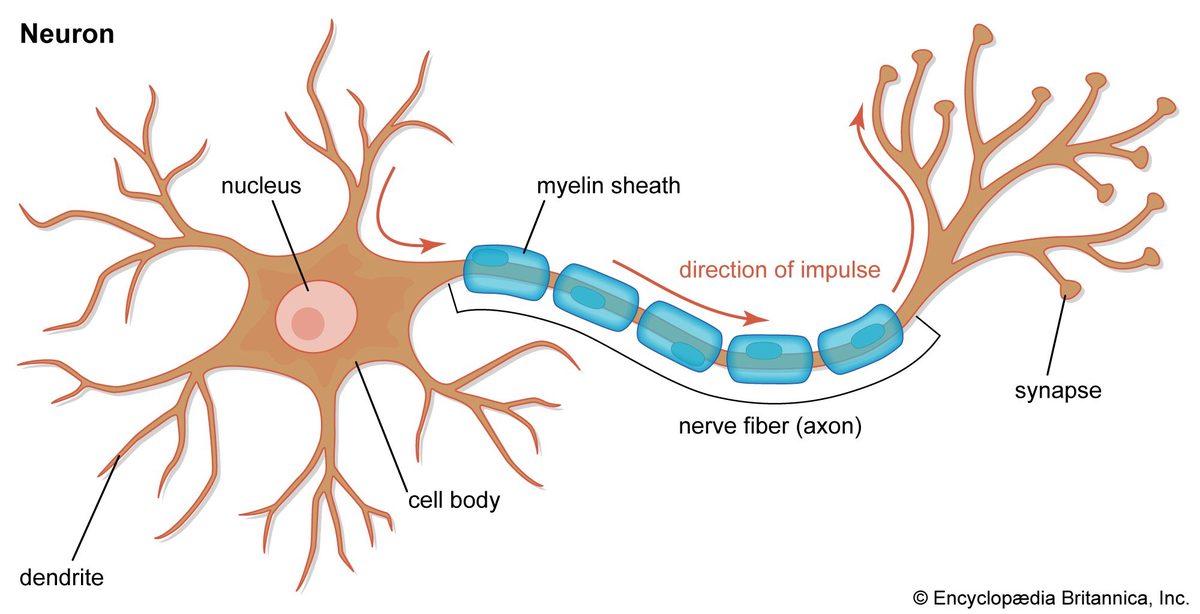
A single neuron is the unit. It has a cell body, or soma, which does the heavy lifting of maintaining cellular function. Inside that soma sits the nucleus. But the real action happens in the extensions.
There are two types. Dendrites and an axon.
Dendrites are usually numerous. They branch out like tree roots. Their job is to receive incoming signals from other neurons and carry them toward the cell body. Think of them as the ears of the neuron.
The axon is different. Typically, there is only one. It is an elongated projection that conducts impulses away from the cell body. It shoots signals out to other neurons, muscles, or glands.
In vertebrates, these axons are often wrapped in a fatty insulating layer called myelin. Why does this matter? Myelin speeds up the transmission of nerve impulses. Without it, your thoughts would crawl. In large animals, these axons can stretch several feet. One axon can connect your spinal cord directly to your foot.
How Neurons Talk
Neurons don’t touch. They leave a tiny gap. This is where the magic of synapses happens.
At these specialized junctions, electrical signals trigger the release of chemical messengers known as neurotransmitters. These chemicals cross the gap and bind to receptors on the next cell. It’s a chemical handshake.
This process allows signals to pass through complex neural networks. It’s how you perceive color. How you feel fear. How you remember a face.
Three Types of Workers
Neurons are often classified by what they do. You can usually split them into three buckets.
1. Sensory neurons
They carry information from receptors—like those in your eyes, ears, or skin—to the central nervous system. The spinal cord or brain receives the data here. It’s the input stream.
2. Motor neurons
These transmit signals from the central nervous system to effectors. Muscles. Glands. They produce movement or secretion. If you decide to wave hello, this is the type of neuron firing.
3. Interneurons
Found primarily within the brain and spinal cord. They connect neurons to one another. They play a key role in processing and integrating information. They are the middlemen. The processors.
The Bundles That Bind
Individual neurons are small. But they don’t work alone.
Bundles of neuron fibers, particularly axons, are grouped together by connective tissue to form nerves. These nerves act as communication pathways throughout the body.
Through these structures, neurons enable organisms to sense their environment. Coordinate responses. Maintain internal balance.
It is all of this working in concert that makes them essential to nearly all aspects of animal life. You are a collection of millions of these tiny, firing wires. And they are talking to each other right now.