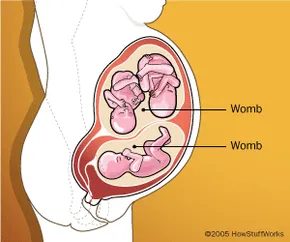
It happens rarely. Incredibly rarely. Estimates suggest it affects anywhere from one in 1,000 to one in 1 million women globally. Sometimes it runs in families. The condition is known medically as uterus didelphys, or what laypeople call a double womb.
The anatomy varies. In some cases, two uteri share a single set of Fallopian tubes, ovaries, a cervix, and a vagina. In other instances, a woman is born with two of everything. Two uteri. Two sets of tubes and ovaries. Two cervixes. Two vaginas. Surgery can join the vaginas into one channel. The uteri, however, usually stay separate.
This happens because the Mullerian ducts in a developing fetus fail to fuse. They are supposed to merge into a single uterus. When they don’t, you get two.
A Statistical Improbability
Consider the odds. In December 2006, three babies were born in Britain to a single woman with a double womb. As far as medical records show, only about 70 women with uterus didelphys have ever been pregnant with one baby in each womb simultaneously. The chance of that happening? Roughly 5 million to one.
Fewer of those women carried one or both babies to term.
Now scale it up. The likelihood of a woman with two wombs carrying three babies—two in one womb, one in the other—is about 25 million to one. Survival rates drop further. The chances of all three surviving are even slimmer.
Hannah Kersey, then 23, defied those odds. Her three daughters might be the only set of triplets born from this specific anatomical configuration in recorded medical history.
“The chances of a woman with two wombs being pregnant with three babies are about 25 million to one.”
How Uterus Didelphys Affects Pregnancy
Having two uteri doesn’t mean pregnancy is impossible. It just changes the landscape. Most women with uterus didelphys can carry a pregnancy to term. But the risks shift.
Preterm birth is more common. The capacity of each individual uterine cavity is smaller than a standard womb. So space becomes a constraint. Babies may grow slower. They may arrive early.
Miscarriage rates are also higher. The structural differences can affect implantation. Blood flow might vary. The cervical shape matters too. If there are two cervixes, each has its own integrity to maintain.
Surgical intervention is rare. Joining the vagina helps with sexual function and hygiene. It doesn’t change the uterine capacity. Doctors typically leave the uteri separate. They can’t fuse them back together.
Why This Matters Beyond the Headlines
Triplet births from a single uterus are rare enough. Triplet births from two separate uteri in a double-womb configuration? That’s another level of statistical anomaly.
It raises questions about fertility treatments. How often does uterus didelphys go undiagnosed? Many women live their whole lives without knowing. They get pregnant. They deliver. No complications arise. The condition remains hidden.
But when complications do occur, the anatomy dictates the response. Multiple pregnancies are high-risk by default. With two ut

The physical constraints of uterus didelphys create a stark biological ceiling. Each uterine cavity is merely half the size of a standard womb. This structural limitation makes carrying a pregnancy to term an uphill battle. Carrying multiple fetuses is often physiologically impossible. There simply isn’t enough space.
Data shows the severity of this restriction. In 25% of cases where a woman carries twins in separate uteruses, delivery is forced by 30 weeks. The uterus tightens. Growth stalls. Doctors usually opt for a cesarean section to prevent further complications. Most uteri cannot stretch enough to accommodate a full-term fetus in this configuration.
How Double Womb Pregnancies Differ from Standard Twins
This scenario diverges significantly from conventional twin pregnancies. In a standard single-womb pregnancy, twins share one environment. In a double womb pregnancy, the fetuses occupy separate, isolated cavities. They can develop independently. This allows for the possibility of delivering babies days, weeks, or even months apart.
However, this anatomical separation introduces complex logistical hurdles. If one baby requires a cesarean section, the surgical risk increases if the second baby remains inside. Few obstetricians are willing to perform major abdominal surgery twice in such a short timeframe. The consensus is usually pragmatic. If surgery is required for one, both babies are delivered simultaneously.
The outcome mirrors a standard twin birth in practice. The mother enters the hospital and leaves with two infants of the same gestational age. The separation of the wombs allows for independent development, but clinical intervention often synchronizes the birth.
Real-World Outcomes and Medical Advances
Historical cases prove that success is possible. In May 2003, a woman in Brazil delivered two healthy babies, one from each womb, according to BBC News. A similar case was reported in China in 2002 by Xinhua. These instances highlight that while rare, simultaneous pregnancies in two uteruses can result in healthy outcomes.
Medical technology continues to evolve. The odds of successful delivery are likely improving. Better monitoring and surgical techniques allow doctors to manage these high-risk pregnancies more effectively than in the past.
Consider the case of Ms. Kersey. She carried triplets in her double uterus. The delivery occurred seven weeks early via cesarean section. The infants spent two months in the hospital, focusing on completing their development outside the womb. By December 2006, all three girls were discharged in good health. Their parents took them home.
The physical architecture of the body dictates the boundaries of pregnancy. When the anatomy is unusual, the medical response must be precise. The gap between physiological limitation and medical intervention is where these stories unfold. There is no guarantee of how the body will react. The womb is a dynamic space. It changes. It limits. It accommodates. The next case may look different.