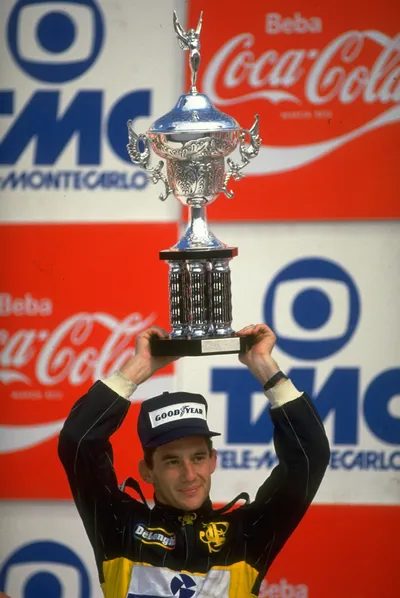
Ayrton Senna was more than just a driver. He’s a helmet-wearing force of nature. Born on March 21, 1960 in São Paulo, Brazil, he grew up surrounded by wealth and privilege. His father, a wealthy businessman, gave him something completely different. a go-kart. Senna first fell in love with the track at the age of four. At the age of 10, he owned a full-size kart. He participated in the competition at the age of 13. This is inevitable. He dominated. He won the South American karting championship twice, in 1977 and 1978. His talent is undeniable.
In 1981, he left Brazil for England. What is your goal? Formula Ford 1600. He drove in Van Diemen. He won races. However, he returned home temporarily due to some matters. The following year he returned to the UK to compete in the 2000 Formula Ford. In 1983, he moved up to the F3 series. This is the second level before the big leagues. He drove for West Surrey Racing. He won the national championship. Won the Macau Grand Prix. Every step was calculated. Every victory was earned.
And then there’s F1.
In 1984, Senna joined Toleman. This is a small team. A underdog car. But the driver was anything but. His debut season was legendary for a reason. In the Monaco GP, he took the lead after 31 laps. The race was stopped due to bad weather. He dropped to second place due to scoring technicality. He should have won. But the result didn’t matter. The performance did. He showed that he could drive on a wet road. He had shown that he can handle the pressure.
He needs a better car. The Lotus team offered the Lotus team. Senna moved to Lotus in 1985. The results followed quickly. He won the Portuguese GP. He won at the Spa-Francorchamps track in Belgium. He finished fourth overall. The world was watching.
Then came McLaren. 1988.
Everything changed this year. Senna joined McLaren and won eight races in one season. A record at the time. In 1988, he won his first F1 World Championship. But the fun is just beginning. His teammate was Alain Prost. In 1989, Prost finished second. The tension between the two men was palpable. It was toxic. It was electric. Prost left for Ferrari at the end of the season. But the rivalry did not end. It has evolved. For the next four years, Senna and Prost defined the era. They were the best of the best.
Senna won six races in 1990 and seven races in 1991, winning the championship both years. The year 1992 was harder. He finished in 4th place. The year 1993 was difficult. He finished second again behind Prost. However, he ended the season on a good note. He won his final race. This was his last victory. His final game in 1993 remains one of his most celebrated performances. It turns out that even if the machine is imperfect, he can still dominate.
Then came May 1, 1994.
San Marino Grand Prix. Imola. Bologna, Italy. The track is known for its difficulty. For its danger. Senna crashed into the concrete barrier. Massive head injuries. He died at the scene. The racing world has come to a standstill. The grief was immediate. Universal.
His career was later depicted in the award-winning film Senna (2010). This film captures the intensity. The skill. The tragedy.
But the numbers are only part of the story.
41 Grand Prix wins. Three-time world champion. 1988, 1990, 1991. These are not just statistics. They are a testament to a driver exceed the limits of human endurance and machine capabilities. he is merciless. he is in danger. he is fearless.
Why are we still talking about him? Why is a traffic accident 30 years ago still so vivid in my mind?
Because Senna doesn’t just drive. He drives with purpose. Strength is