


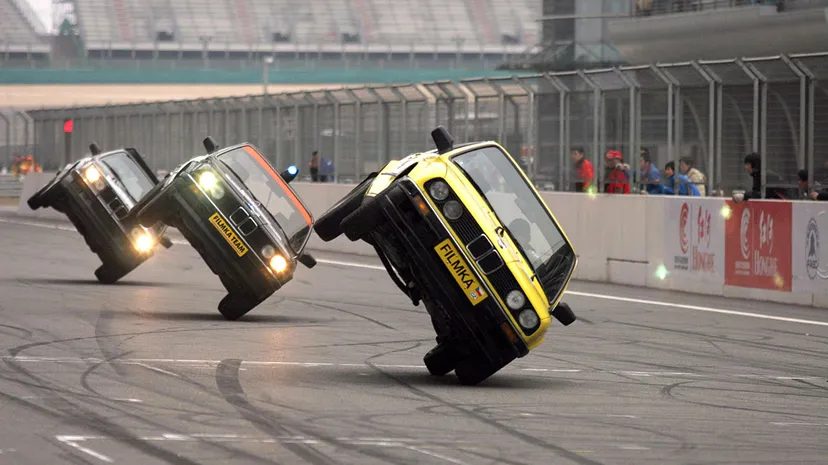
You picture slick commercials. Stunt drivers dancing through traffic. Maybe a bit of Fast and Furious fantasy where cars move as one organism. BMW has certainly fed that image. But Ben Bowlin and Scott Benjamin on the CarStuff podcast argue that synchronized driving is shedding its glossy marketing skin. It is evolving into something far more complex. And potentially, far more useful.
Remember when car manufacturers actually showed off what their machines could do? Hyundai used to field teams that didn’t just drive cars—they weaponized them. They’d balance on two wheels. Passengers changed tires mid-drive. Vertical ascent. No safety nets. Just physics and nerve. Isuzu drivers still tour Australia with similar feats. These weren’t just ads. They were proof of concept. Proof that even a modest sedan could handle chaos if the hands behind the wheel were perfectly coordinated.
But the definition of coordination is shifting.
It’s no longer about human reflexes. It’s about data. The Senseable City Lab at MIT is studying vehicles that communicate via sensors. They don’t care for traffic lights. They don’t stop. They slot into intersections like pieces of a puzzle. Cars talk to a central hub and to each other. The result? A traffic flow that ignores the red light. It ignores the wait. It creates efficiency where there used to be gridlock.
The future of traffic isn’t about waiting for a green light. It’s about negotiating space in real-time.
This shift raises serious questions. If a network can drive itself, why do we need perfect eyesight? Why do we need lightning-fast reflexes? Maybe a limited license for those with physical constraints becomes viable. The cars do the heavy lifting. The network handles the risk.
Or does it?
Consider the fragility of a system reliant on constant communication. One car loses signal. One sensor fails. The harmony breaks. Chaos ensues. It’s the digital equivalent of a stunt gone wrong. Except this time, it’s not a movie set. It’s rush hour. The stakes are higher. The consequences are immediate.
Bowlin and Benjamin unpack these tensions. They look back at the famous commercial stunts that got us here. They look forward to the synchronized driving networks that might redefine how we commute. The technology is promising. The infrastructure is untested. The human element is suddenly optional.
If you want to see how the illusion is built, dig into the planning behind BMW’s “Driftmob.” It details the execution of that synchronized driving spectacle. It’s impressive. It’s terrifying. It’s a glimpse of a world where cars move like a school of fish. Or a traffic jam. Depending on how the code holds up.


