


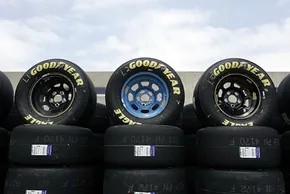
Goodyear Racing Eagles look like street tires if you squint. They share DNA with your daily driver’s rubber. But strip away the assumptions. What you are looking at is a machine built for one purpose: speed. For a full breakdown of street tire anatomy, check out How Tires Work. The real story lies in the components that don’t show up on regular tires.
These parts define the Racing Eagle.
- Apex – This controls sidewall stiffness. Rigidity matters.
- Bead – The contact zone between tire and rim. Some tracks demand two beads.
- Carcass Piles – The backbone. They provide structural support and strength to the tire’s crown.
- Belt Package – Steel braided belts sit between the tread and piles. This creates a flat footprint.
- Inner Liner – A backup layer. It keeps air in if the outer tire fails or gets punctured.
- Tread Compound – The grip provider. The actual contact patch.
The biggest visual difference between a Racing Eagle and a Goodyear Eagle F1 street tire is obvious. No tread. Don’t let the smooth surface fool you. Lack of grooves doesn’t mean lack of grip. These are slicks. Slick racing tires feature smooth surfaces for a reason. Mechanical grip in a race car comes from maximizing surface area against the track. Smooth tires have no grooves to cut into the asphalt. That means a larger contact patch and optimal traction.
Building a tire takes effort. One critical step is curing. This process sets the compound. But racing tires face extreme heat and stress constantly. That heat changes how the tire grips mid-race. Temperature plays a massive role in performance. We will dig into that later.
If you have watched NASCAR before, you have heard sticker tires. This term refers to brand new Goodyear Racing Eagles. Crew chiefs and fans use the phrase because of the large data sticker label on the rubber. NASCAR teams don’t remove the sticker before mounting. They grab the fresh set with the label intact. The sticker holds key data. It lists the spring rate (a fancy term for tire stiffness), the tire code, and the sequence number. Teams often try to match tire numbers in sequence. The goal is consistency. Many believe matched tires from the same batch perform identically together.
Next, we explore tire testing and why teams wait in line for these Eagles.
Wet Weather Racing Reality
Slicks are great. Dry asphalt is better. But what happens when it rains in NASCAR? The answer is simple. Postpone the race. NASCAR stock cars and trucks rely on centrifugal force and aerodynamic downforce for traction. Driving a stock car on a wet oval is not feasible. It is dangerous. It is slow.
In other forms of motor racing, the race continues. Motorcycles are the exception. Most vehicles switch to rain tires. Formula 1 calls them wets.
Goodyear makes rain tires. But only for road courses. Oval tracks remain off-limits.
History shows the attempt. In 2002, NASCAR and Goodyear tried an exhibition race in the rain. It happened on a road course in Japan. The 2008 Nationwide Series saw the first competitive use of rain tires. The race took place in Montreal, Canada.
Speeds drop significantly. But the grooves work. Similar to street tires, they divert water. This gives cars ample handling on wet surfaces.


