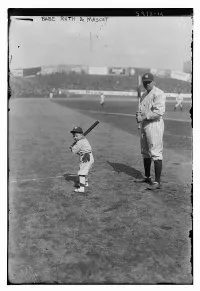
Babe Ruth was tired. The baseball legend had spent his twilight years banging against the door of management roles that never materialized, watching his body slow down while his ego stayed exactly the same. But 1934, despite the general decline, offered a few bright flashes. The biggest was his 700th home run, a milestone he had publicly set his sights on long ago.
The date was July 13. The location? Tiger Stadium in Detroit. The pitcher? Tommy Bridges.
The shot traveled 480 feet. It was a fitting end to a chapter. At that precise moment, Ruth stood alone at the pinnacle of power hitting. Lou Gehrig and Rogers Hornsby were the only other players in Major League Baseball with even 300 career homers. The gap between Ruth and everyone else was widening, a chasm of dominance that no one else could cross.
Yet, the numbers didn’t matter as much as the narrative. Team owner Colonel Jacob Ruppert had suggested earlier that summer that Ruth might stick around as a pinch hitter. Ruth took this as an insult. He drew a hard line in the dirt: he would only stay if he could also manage. Since no one believed he could, and since Ruppert wasn’t budging, the writing was on the wall. His playing days were numbered.
The Return to Boston
The baseball world knows Boston as the place where Ruth began, but in August 1934, it became the place where he was worshied as a returning hero.
The Boston Globe ran a headline that captured the hysteria: “Fans Storm Fenway Park In Tribute To Babe Ruth.” They reported that gates closed early because 15,000 fans were left milling outside. The final count for the August 12 doubleheader against the Yankees was a staggering 46,766. It was a Fenway record. Thousands more were roped off in the outfield, watching from the grass.
Ruth started both games. It was the first time he had played a full doubleheader all season, and the crowd lost its mind.
In the opener, he went hitless but drew walks. The Sox pitchers walked him twice. The fans booed. They didn’t care about the walks. They cared about the legend. When Ruth bobbled Billy Werber’s liner to bring in Boston’s winning run, the official scorer showed mercy, scoring it as a triple for Werber to avoid giving Ruth an error. The crowd looked the other way. They saw what they wanted to see.
Ruth doubled in the action. He waved to the stands. It was electric.
Twenty years to the day after he stepped off the train in Boston and pitched his first American League game for the Red Sox, Ruth tipped his cap. He left midway through the second game to a standing ovation. Most Bostonians thought that was it. They thought they had seen the last of Babe the player.
They were wrong. But they wouldn’t see him at Fenway again.
The Fade Out
The Boston turnout was the high-water mark of a dismal season. Contrast that with the final home game at Yankee Stadium on September 24, 1934.
The weather was breezy and overcast. The attendance was around 2,000 people. There was no official farewell announcement. There was no ceremony. Ruth walked in the first inning. He limped down the line. He was pulled for a pinch runner. The applause was thin. It was a stark contrast to the roar that had greeted him when he hit the first home run at that stadium over 11 years prior.
The magic was fading.
The season ended six days later in Washington. The St. Mary’s band, perhaps paying back Ruth for his 1920 fundraising efforts that saved their school, traveled from Baltimore. They played for Ruth and 15,000 fans. Ruth received a testimonial signed by thousands, including President Franklin Roosevelt.
He took the microphone. “I’d like to stay in baseball,” he told the crowd. “As long as I can do anybody good.”
He went hitless in three at-bats. He did score on a walk. By the eighth inning, Myril Hoag was in right field. The Yankees were moving on.
Photos from that day tell the story better than the stats. One shows a tired, aging Ruth towel-drying his face in the clubhouse, smiling wanly. Another shows him being whisked through a crowd by policemen, hat pulled low over his eyes. He looked tired. Disillusioned. He seemed oblivious to the young kids crowding around him for autographs. The magic was gone.
The Final Negotiation
The talk of where Ruth would go next continued. He left for “cover” the World Series with the Christy Walsh syndicate, but first, he went to Jacob Ruppert’s office. He wanted an answer.
He asked one question: “Are you satisfied with McCarthy as your manager?”
Ruppert replied, “Of course I am. Aren’t you?”
Ruth said no. He thought he could do a better job. The conversation ended there. Ruppert had no plans to fire Casey McCarthy. Ruth walked out of that office for good.
Later, in St. Louis, the Cardinals won the 1934 World Series in seven games. But the bigger story came from Ruth’s lips to three New York sportswriters.
“I’m through with the Yanks,” he said. “I won’t play for them again unless I can manage. But they’re sticking with McCarthy, and that lets me out.”
So where did Babe Ruth end up? The question hung in the air as the 1934 season closed. He was done with New York. He was done with the Yankees’ management style. The legend was looking for a new field, a new role, and a new way to stay in the game.
For more information about baseball history:
-
Baseball
-
Minor League Baseball
-
Baseball Hall of Fame