The 1920 New York Yankees had a center field problem.
Chick Fewster was gone. Frank “Ping” Bodie left, too. That left Miller Huggins, the manager, with a gaping hole in the outfield. Enter Babe Ruth. The slugger asked if he could try center field. He had a simple reason. He didn’t want to smash himself against the short walls of the Polo Grounds while chasing fly balls.
Huggins said yes.
Opening day in Philadelphia. Ruth took the field. And he dropped a fly ball in the eighth inning. The last-place Athletics scored twice. They won the game. It was an embarrassing debut for the future icon.
He was back in right field quickly. That’s where he stayed for the rest of his career. But that first failure? It taught him something. He learned how the public reacted. He learned how to play his own image.
The Derby Hat and the Rib Muscle
The next day, the American League didn’t let up. A messenger ran to home plate while Ruth was batting. He handed him a package. Ruth opened it. Inside was a brown derby hat.
In that era, a derby meant you were incompetent. It was a symbol of failure. Umpires laughed. Fellow players smirked. Everyone expected the Babe to explode.
Instead, he grinned. He tipped the hat to the fans. He waved.
It was a masterclass in crowd control. He knew exactly what they wanted.
But the games? They were a disaster.
Ruth had two weak singles in the opener. He struck out three times the next day. The Yankees got swept by the Boston Red Sox in Boston. The team returned to New York, hoping for a turnaround.
It didn’t come.
Ruth pulled a muscle in his rib cage during batting practice. He pulled it again after striking out in the first inning. He left the game. The home crowd booed loudly. He didn’t play for several days.
April ended with zero home runs.
Eleven games played. No long balls. Huggins had predicted thirty-five. The number looked like a joke.
The Roof-Shatterer
May 1. The Red Sox were in town.
Boston was a surprise team. They sat in first place with a 10-2 record. Everyone expected them to crush the struggling Yankees.
They did, sort of.
In the second game of the series, Ruth stepped to the plate. He faced Herb Pennock. He swung. The ball flew.
It went over the Polo Grounds roof.
It traveled farther than his record-breaking twenty-eighth homer from the previous September. It was a statement.
“Throughout his career of twenty years, Ruth never changed the basics of that gorgeous, gargantuan arc.”
The moment marked the start of New York’s march out of the second division. It also began Francis Frazee’s “fabulous flops” as the team climbed the standings.
Ruth homered again the next day. The Yankees swept the series.
The rest of the season would be historic.
Six Home Runs in Six Days
April was empty. May changed everything.
Ruth hit twelve home runs in May. Late in the month, he hit six in six days. Three of them came against the Red Sox at Fenway Park.
The crowds at the Polo Grounds grew by the day. Some 15,000 fans were turned away on Sunday, May 16. A record 38,600 people packed the stadium. Police had to shut down the ticket windows to prevent a riot.
June brought another twelve homers.
A doubleheader against Washington on June 2 saw him hit three in one day. He started a consecutive-game hitting streak. It lasted twenty-six games. It ended in mid-July.
By July 11, his batting average stood at .385.
This number matters. It destroys the myth of the “all-or-nothing” swinger.
The Mechanics of the Arc
We remember Babe Ruth as a chaotic, heavy-handed hitter. Movies show him swinging wildly. They show him missing everything and hoping for the best.
That’s not true.
His career batting average was .342. His highest was .393. That isn’t undisciplined. That is elite consistency.
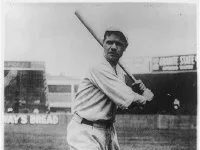
Look at Joe Jackson. The great left fielder. The Black Sox scandal banished him, but his mechanics lived on. Jackson stood with his feet twenty inches apart. He put weight on his rear left foot. He aimed his right shoulder at the pitcher. His swing looked like a propeller.
Ruth copied it. But he tweaked it.
He kept his feet eight to nine inches apart.
This narrow stance allowed for a quicker pivot. It also made it nearly impossible to check a swing. If he started the move, he had to finish it.
He began his upward cut with his back almost to the pitcher. He twisted around as the ball arrived. This gave his wrists an extra twist at contact.
It was precise. It was powerful. It was exhausting.
Did he miss? Often.
His unorthodox stance meant he ended up cross-legged on the ground half the time. He looked like a pretzel. Fans loved it. They loved watching him sprawl out after a mighty miss.
Grantland Rice wrote that watching Ruth go down swinging was almost as exciting as seeing him hit a home run.
Ruth leaned into the chaos. He told reporters, “Once my swing starts, I can’t change it or pull up on it. It’s all or nothing.”
It wasn’t just luck. It was hard work. It was great eyesight. It was timing. It was coordination.
He altered his grip when he needed to. He adjusted his stance. But the core of the swing remained the same. A gorgeous, gargantuan arc.
The 1920 season proved that the Babe wasn’t just a fluke. He was a masterpiece of mechanical adaptation. And the Polo Grounds roof never forgot it.
The crowd kept coming back. The stats kept climbing. But the image of him sprawled on the dirt, swinging for the fences, stayed.
The Physics of Power and the Price of Fame
He could bunt. He could hit to the opposite field when strategy demanded it. But nobody remembers a hitter who choked up on the bat with two strikes. It didn’t matter if the pitch was at his knees or near his armpits. Babe found a way to power it. Long, arching drives. Out of the park.
Other batters might have generated more raw bat speed. Lou Gehrig, his future teammate, is the prime example. Nobody hit the ball as far or as high. Consider the first sixteen home runs Ruth hit at the Polo Grounds in 1920. All of them cleared the second deck or vanished completely into the night air. The legend says Babe hit infield pops so high he reached second base before the outfielders could react.
This prodigious power wasn’t magic. It was leverage. He swung a bat weighing between 42 and 46 ounces. At least a pound heavier than the average stick used by major leaguers of the era.
W.O. McGeehan of the New York Herald-Tribune captured it best.
“Home runs executed by Babe Ruth are not mere home runs. Each home run seems to possess an individuality and eccentricities of its own. After the game the multitudes linger in the lot to trace the path taken by the ball.”
But the spectacle wasn’t just about physics. It was about the man behind the swing. Babe Ruth was a magnet for trouble. He met everyone. He caused problems. The off-field chaos was as legendary as the on-field dominance. We’ll dig into those troubles next.