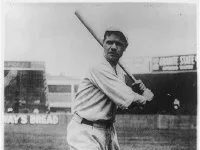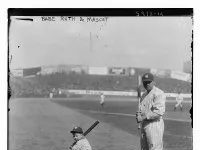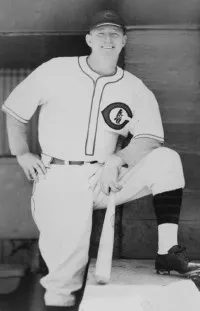
By 1932, Babe Ruth’s body was a wreck. Nineteen years of professional baseball had taken a toll. His joints ached. His muscles failed. But he was not done yet. In fact, his most iconic moment was still waiting in the wings. The legend wasn’t built on health. It was built on spite.
A Broken Body, An Unbreakable Team
Ruth spent the 1932 season with the New York Yankees in constant pain. He had a charley horse here. A sprain there. An old knee cartilage tear flared up with regular frequency. He ripped a muscle in his leg in July and sat out for nearly two weeks. The pain was so bad he stopped playing golf. It was his favorite hobby. He couldn’t even enjoy that anymore.
He thought he had appendicitis in September. Doctors didn’t cut him open. They just packed him in ice for three days. Ten days later, he cracked, “I still haven’t thawed out.”
His legs became such a liability that pinch runners Sammy Byrd and Myril Hoag got the nickname “Babe Ruth’s legs.” He was subbed out late in games. He was replaced defensively. He was a walking injury.
Yet the Yankees scored 1,002 runs. No team had ever done that. Only two others have since. That is an average of 6.5 runs per game. Lou Gehrig hit 34 homers. Ruth hit 41.
In one June game, Gehrig hit four home runs. Ruth hit one. They won 20-13. It was a massacre.
Ruth didn’t win the home run title. Jimmie Foxx of the Philadelphia Athletics did. It was only the second time since 1917 that Babe hadn’t led the league in homers. Foxx also beat him in slugging. The A’s took batting average and slugging percentage.
But the Yankees pitching was dominant. Lefty Gomez had his second straight 20-win season. Red Ruffing won 18. Johnny Allen won 17. George Pipgras won 16. The staff led the league in earned run average.
They jumped into first place in late May. They finished 13 games ahead of Philadelphia. Leading in ERA and scoring a thousand runs meant one thing. The pennant was theirs.
The Cub Trap
The opponent in the World Series was a circus act. The Chicago Cubs had won the National League flag in 1929 under Joe McCarthy. McCarthy became the Yankees manager. The Cubs replaced him with Rogers Hornsby.
Hornsby was a slash-and-burn manager. The team finished 17 games out of first in 1931. He kept his job. Then he lost it in August 1932 while the team was in first place.
The Cubs were in a tight race with Pittsburgh and Chicago. They fired Hornsby. They hired Charlie Grimm. Grimm was known as “Jolly Cholly.” He played the banjo too much. He was traded from the Pirates for it.
Historian Bill James noted that when a team hates a strict manager, ownership should give them a fun-loving one. The Yankees tried that with Miller Huggins. It didn’t work. The Cubs did. They caught fire. They got Mark Koenig from the Yankees. Koenig batted .353 in 31 games.
The Penny-Pinchers
The tension boiled over during World Series share votes.
The Cubs were cheap. They gave Koenig just a half-share. They gave Hornsby nothing. The Yankees thought it was the ultimate in cheapness. Every Yankee voted generously. A trainer got three-quarters. Charlie Devens, a rookie who pitched nine innings, got a half-share.
The Yankees also felt McCarthy had been mistreated by Cubs management. He was axed suddenly. They were angry.
Before game one, the badmouthing started. The Yankees called the Cubs “penny-pinchers,” “tightwads,” and “skinflints.” The Cubs hollered back. The tone was like an Ozark feud. The press joined in. It never stopped.
The Series Begins
Game 1 started with Guy Bush retiring the Yankees. Then he walked Earle Combs in the fourth. Ruth singled in the first run. Gehrig followed with a home run.
Bush fell apart in the sixth. He walked four Yankees. New York led 8-2 by the end of the inning. They won 12-6.
Lon Warneke opened Game 2. He walked the first two Yankees. Two runs scored. Two more walks in the third cost him two more runs. Lefty Gomez shut them out the rest of the way. Yankee Stadium wasn’t sold out. The Depression was hitting hard.
Game 3 changed everything. It was rowdy. It created a legend.
The Curse of the Bambino
The Cubs were heading home to Wrigley Field. Chicago fans were crazy. It was one of those days where the wind blows out. Every pitcher feels doomed.
The fans chided Ruth. They mocked the Yankees.
Babe stuck it back in their faces. He hit nine balls out of the park in batting practice. Gehrig hit seven.
The Chicago crowd went wild. Or maybe they went silent. The story says he pointed to the center field bleachers. He pointed. Then he hit it.
Some say he cursed the Cubbies. Others say he was just showing off. But the image remains. A broken old man. A stadium full of haters. And a ball that traveled forever.
Did he really do it? The facts are fuzzy. The legend is solid.
The air in Wrigley Field wasn’t just hot. It was thick with lemon-scented rage.
Babe Ruth had just shouted at the Cubs bench, mocking their field as a “dump” and saying he’d play for half his salary if he could hit there every day. The crowd didn’t clap. They didn’t boo. They threw lemons.
Ruth, ever the showman, tossed them back.
But the real violence was verbal. By Game 3 of the 1932 World Series, tempers had snapped. It wasn’t just a game anymore. It was a war of egos, played out under the Chicago sun.
The Stage Is Set
The Yankees started hot. Billy Jurges, filling in for the injured Everett Scott, threw wildly on the first pitch. Joe Sewell walked. Then came Ruth.
He didn’t stride. He didn’t grunt. He casually launched a homer into the right-field bleachers. 3-0.
The lemon deluge began in earnest.
In the second, Ruth backed Kiki Cuyler into the wall. Cuyler barely snagged the fly, fingers brushing the wall inches from the outfield grass. It should have been an out. It wasn’t.
Gehrig followed with a solo shot in the third, but Chicago fought back. They scored twice in the third. They scored one in the fourth. The game tied at 4-4.
Here is the stakes.
A Yankees win meant a 3-0 Series lead. Unreachable. A Cubs win brought them to within one victory of a tie. The tension in the ballpark was physical. You could feel it in your teeth.
The At-Bat That Broke Reality
Top of the fifth. One out. Ruth stepped into the box.
The Cubs bench was screaming. The fans were hurling insults so vile they made the earlier lemon-throwing look like a schoolyard spat. Pitcher Charlie Root threw a curveball inside.
Strike one.
Ruth held up one finger.
The crowd roared. The benches screamed. Root threw again. Ball one. Strike two.
Ruth held up two fingers. He mouthed the old cliché: “It only takes one.”
Guy Bush, the Cubs reliever, lost it. He ran halfway out of the dugout, screaming obscenities at Ruth. The entire stadium was vibrating. Bedlam.
Then, the gesture.
Ruth waved his bat. He pointed his right hand. Some say he pointed to the Cubs bench, promising to foul the next pitch off their heads. Others say he pointed to the pitcher, threatening to drop a knee on Root. Most historians agree he pointed to centerfield.
He pointed to the bleachers.
Root, trying to fool the legend, threw a slow curve inside.
Ruth cracked it.
The ball flew. It didn’t just clear the fence. It sailed into the centerfield bleachers at Wrigley. The longest home run anyone had ever seen at that park. It was his 15th, and final, World Series homer.
Gehrig followed with another blast. The Yankees reasserted dominance.
The Legend is Born
After the game, a reporter wrote that Ruth had “called his shot.” Pointed to the bleachers. Hit it there.
No one else seemed to notice.
Gehrig said, “Did you see what that big monkey did? He said he’d hit a homer, and he did.”
The story spun. Within days, it was myth. Ruth, never shy about embellishing his own legend, claimed he had planned it the night before. Listen to the tape at Cooperstown today.
“I told him I was going to hit the next pitched ball right into centerfield for a home run.”
Did he?
We will never know. Ruth had flair. He had drama. He had the 1914 catch in Baltimore. He had the 1928 Series running grab. But this? This was different.
As Roger Kahn noted, where Ruth stood, the center stage moved with him. After the Series, Ruth said, “That’s the first time I ever got the players and the fans going at the same time. I never had so much fun in my whole life.”
It was the ultimate Ruth quote.
A film found in 1992 seems to show him pointing to centerfield. But he was waving his arms everywhere that day.
Ask the participants.
Gabby Hartnett, the Cubs catcher, flatly denied it. Ruth didn’t call a shot.
Charlie Root, the pitcher, was equally blunt. “Anyone who knows me knows [if Ruth had tried that] he would have ended up on his [backside].”
Root refused to re-enact the scene for a biopic fifteen years later. He wasn’t having it.
The debate rages. Was it a psychic feat? A bluff? A misremembered moment of madness?
Whatever happened, one thing is clear.
Babe Ruth did something positively Ruthian.
As biographer Tom Meany wrote, “It was slightly colossal.”
The Series Continues
Game 4 offered no relief. No closure.
The Yankees started with two singles. Ruth took a wicked fastball from Guy Bush—the same bushman who had nearly stormed the field in Game 3.
“Was that your fastball?” Ruth shouted. “I thought it was a gnat.”
The arm swelled. The injury was real. Ruth wouldn’t play Game 5.
The Yankees scored one. Gehrig with a massive sacrifice fly. Chicago answered with four runs in the bottom half.
Lazzeri hit a two-run homer in the third. Two more runs in the sixth. The Yankees led.
But Chicago struck back. A solo tally. Tied again.
Seventh inning.
“Five O’Clock Lightning” struck in all its fury.
The Yankees didn’t just win; they suffocated the opposition. Four runs in one inning. Ruth managed to drive one in despite an arm that felt like it was on fire. Then came the ninth. Lazzeri launched his second two-run homer. The scoreboard read 13-6.
Twelve straight World Series victories. No one has done it. No one will. It’s a stat that feels less like sport and more like myth.
Ruth gave us the drama. The grimace. The swing that defied physics and pain. It’s the stuff legends are made of. But the era was shifting. The torch wasn’t just being passed; it was being grabbed.
Gehrig Takes the Crown
Lou Gehrig didn’t just step up. He eclipsed.
While Ruth was .333, Gehrig was posting a .529 average. Three home runs. Nine hits. Eight RBIs. He led every batter in the Series. He wasn’t just matching Ruth’s legacy; he was rewriting it.
Ruth’s game? It was still elite. But the decline was there. Subtle to the casual eye, glaring to the student of the game. The power was still there. The mechanics were slipping.
The End of an Era
This wasn’t just a loss. It was a transition. The Ruth era was winding down. Gehrig was taking over. The slugging mantle wasn’t being lent. It was being claimed.
Ruth’s abilities continued to fade. Not overnight. But steadily. The numbers don’t lie. The eyes don’t lie.
For more on the history of the game, check out Baseball, Minor League Baseball, and the Baseball Hall of Fame.